
Course: Prep4Uni Physics 1
Chapter 1: Quantities and Measurement |
Chapter 2: Forces and Moments |
Chapter 3: Motion and Forces |
Chapter 4: Energy and Fields |
Chapter 5: Projectile Motion
Projectile Motion: Overview
This topic focuses on the motion of objects under the influence of gravity, especially when launched with an initial horizontal or angled velocity. It also introduces the effects of air resistance and the concept of terminal velocity, helping you develop both qualitative and quantitative understanding of real-world projectile motion.
Projectile Motion: Contents
- Free Fall and Gravitational Acceleration
- Gravitational Potential Energy
- Analyzing Projectile Motion
- Air Resistance and Terminal Velocity
- Qualitative Description of Motion with Air Resistance
Projectile Motion: Learning Outcomes
By the end of this section, students should be able to:
- Understand weight as a force in a gravitational field
- Analyze motion with perpendicular velocity and acceleration components
- Derive and use the gravitational potential energy equation: ΔEp = mgΔh
- Describe the qualitative effects of air resistance on motion
- Understand the concept of terminal velocity
1. Free Fall and Gravitational Acceleration
- Weight (force due to gravity): W = m g.
- Units: W in newtons (N); m in kilograms (kg); g in N kg-1 (equivalently m s-2).
- Direction: g points toward Earth’s centre (downward near the surface).
A 3 kg object in free fall experiences a weight of:
W = m g = 3 × 9.8 = 29.4 N.
Answer: W = m g = 4 × 9.8 = 39.2 N.
Answer: False — in a vacuum, all objects fall at the same rate (g).
2. Gravitational Potential Energy
- Energy conversion in free fall: GPE decreases while kinetic energy (KE) increases.
- Total mechanical energy: (GPE + KE) stays constant if air resistance is negligible.
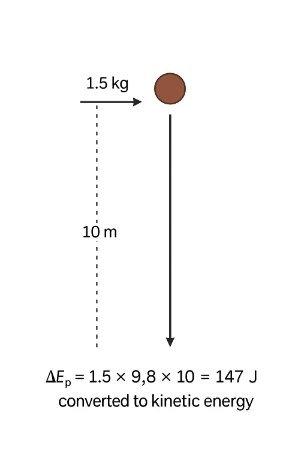
A 1.5 kg rock falls 10 m.
ΔEp = m g Δh = 1.5 × 9.8 × 10 = 147 J (converted to KE).
Answer: ΔEp = m g Δh = 0.8 × 9.8 × 2.5 = 19.6 J.
Answer: GPE decreases while KE increases; total mechanical energy is conserved.
3. Analyzing Projectile Motion
- Horizontal motion has constant velocity (no horizontal force).
- Vertical motion has constant acceleration due to gravity (a = ±g).
- Horizontal and vertical motions are independent and linked only by time t.
Vertical-motion equations (constant acceleration):
- v = u + at
- s = ut + ½at2
- v2 = u2 + 2as
- Acceleration is the rate of change of velocity: a = (v − u) / t.
- Rearrange: v − u = at ⇒ v = u + at.
Sign choice in vertical motion: upward throw ⇒ a = −g; downward fall ⇒ a = +g (if down is positive).
- Average velocity with constant acceleration: vavg = (u + v) / 2.
- Displacement s = vavg t. Substitute v = u + at:
s = [u + (u + at)] / 2 · t = ut + ½at2.
- From Derivation 1, t = (v − u) / a.
- Use s = [(u + v) / 2] · t and eliminate t:
s = [(u + v) / 2] · [(v − u) / a] = (v2 − u2) / (2a) ⇒ v2 = u2 + 2as.
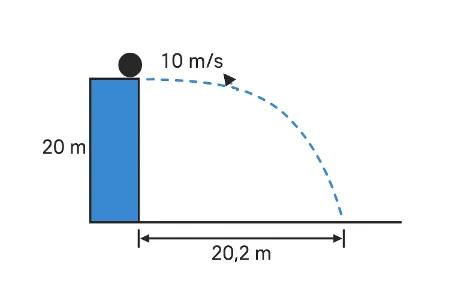
A ball is thrown horizontally at 10 m/s from a height of 20 m.
- Vertical time from s = ½gt2: t = √(2s / g) = √(40 / 9.8) ≈ 2.02 s.
- Horizontal range (constant speed): R = vx t = 10 × 2.02 ≈ 20.2 m.
Answer: R = vx t = 12 × 3 = 36 m.
Answer: Gravity (magnitude g ≈ 9.8 m s-2).
4. Air Resistance and Terminal Velocity
How drag depends on speed:
- Low–moderate speeds: D ≈ k v (proportional to speed).
- Most real falls (bluff bodies): D = ½ ρ Cd A v2, where ρ is air density, Cd is drag coefficient, and A is cross-sectional area.
Terminal velocity:
- As speed rises, drag grows until it equals weight: D = mg.
- The net force becomes zero and the object falls at a constant speed called terminal velocity vt.
- With quadratic drag: vt = √[(2 m g) / (ρ Cd A)].
What affects terminal velocity vt?
- Mass m: heavier ⇒ larger vt.
- Area/shape (A, Cd): bigger or flatter ⇒ more drag ⇒ smaller vt.
- Air density ρ: denser air ⇒ more drag ⇒ smaller vt.
Take m = 80 kg, ρ = 1.2 kg m-3, and CdA ≈ 0.70 m2.
vt = √[(2 × 80 × 9.8) / (1.2 × 0.70)] ≈ 43 m s-1 (≈ 155 km h-1).
Answer: It becomes zero since D = mg and forces balance.
Answer: Larger area A increases drag, so force balance occurs at a lower speed.
5. Qualitative Description of Motion with Air Resistance
Without Air Resistance (Idealized)
- Path is a symmetric parabola.
- Horizontal speed is constant; vertical acceleration is −g.
- Maximum range at 45° for level launches.
- Time up = time down for equal levels.
With Air Resistance (Real World)
- Path is asymmetric (flatter rise, steeper fall).
- Horizontal speed decreases continuously due to drag.
- Peak height and range both decrease.
- Angle for max range is < 45° (typically 35–42°).
What controls the effect of drag?
- Shape & area (A) and drag coefficient (Cd): bigger/flatter ⇒ more drag.
- Speed: drag grows with speed (≈v2), so high-speed projectiles deviate more.
- Air density (ρ): denser air ⇒ more drag.
- Mass (m): heavier projectiles are less affected (higher momentum).
Two balls launched at the same speed and angle: a light foam ball and a dense steel ball of equal size. The foam ball loses horizontal speed much faster, resulting in a far smaller range and peak height; the steel ball flies closer to the vacuum parabola.
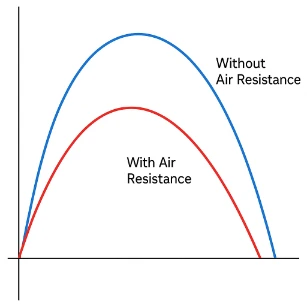
Answer: Drag makes the path asymmetric, with a shorter range and lower maximum height than the vacuum parabola.
Answer: The projectile accelerates less rapidly than g because upward drag opposes the fall, approaching terminal velocity as speed grows.
Key Concepts Recap
| Concept | Formula | Notes |
|---|---|---|
| Weight | W = m g | Force due to gravity. |
| Gravitational potential energy | ΔEp = m g Δh | Change in height Δh from a reference level. |
| Free fall (vacuum) | a = g ≈ 9.8 m s-2 | Uniform downward acceleration. |
| Projectile horizontal range | Range = vx × t | Horizontal motion is uniform (no drag). |
| Terminal velocity | Fair = m g | Net force = 0 ⇒ constant speed. |
Interactive Simulator: Projectile Trajectory Calculator
2D Projectile Motion Trajectory Visualizer
Adjust launch parameters to calculate flight time, horizontal range, maximum height, and plot the parabolic trajectory with explicit axes.
Interactive Review Questions
Review Question 1: Why are horizontal and vertical motions in projectile problems treated independently?
Perpendicular forces do not affect velocity in orthogonal directions. Since gravity acts strictly downward, there is zero horizontal acceleration (ignoring drag), leaving horizontal velocity constant while vertical motion undergoes constant gravitational acceleration g.
Review Question 2: At what launch angle is horizontal range maximized in a vacuum for level ground?
In a vacuum, horizontal range is given by R = (v2 sin 2θ) / g. Range is maximized when sin 2θ = 1, which corresponds to 2θ = 90° or θ = 45°.
Review Question 3: How does air drag change the launch angle required for maximum range?
Air resistance continuously reduces horizontal velocity over time. To minimize flight duration while maintaining forward momentum, optimal launch angles shift below 45° (typically between 35° and 42°).
Frequently Asked Questions
Does the mass of a projectile alter its trajectory in a vacuum?
No. Gravitational acceleration g is independent of object mass. In a vacuum, all projectiles launched with identical initial velocities and angles follow identical trajectories regardless of mass.
What is the velocity of a projectile at its highest point?
At peak height, the vertical velocity component is zero (vy = 0). However, the overall velocity is not zero, as the horizontal component (vx = u cos θ) remains active.
Why does a skydiver stop accelerating when reaching terminal velocity?
As speed increases, upward drag force grows until it equals downward gravitational force (weight). At this point, the net force becomes zero, producing zero acceleration according to Newton's First Law.
Consolidated Cluster Navigation
Classical Mechanics Sub-Hub
Master baseline physical dynamics and foundational mechanics principles across course pathways. Visit Classical Mechanics
Dynamics and Kinematics
Analyze dynamic motion models, vector resolution, and accelerated kinematic equations. Visit Dynamics & Kinematics
Newton's Laws of Motion
Explore net force relationships, acceleration principles, and action-reaction pairs governing free fall. Explore Newton's Laws
Previous Chapter: Energy and Fields
Review potential fields, work-energy transformations, and power calculations. Return to Chapter 4
Practice Module & Exercises
Section 1: Foundational Concept Review Questions (8 Questions)
- Define free fall in classical physics.
Answer: Motion where gravity is the only acting force on an object (ignoring air resistance). - What is the standard value of gravitational acceleration near Earth's surface?
Answer: g ≈ 9.8 m s-2 (or N kg-1). - State the formula linking mass, gravity, and weight.
Answer: W = m g. - Write the formula for change in gravitational potential energy near Earth.
Answer: ΔEp = m g Δh. - Why is horizontal velocity constant in ideal projectile motion?
Answer: Because no horizontal forces act on the projectile in a vacuum (zero horizontal acceleration). - Define terminal velocity.
Answer: The constant speed reached when upward drag force equals downward gravitational force (weight). - What happens to net force when an object reaches terminal velocity?
Answer: Net force becomes zero (forces are balanced). - How does air resistance affect the symmetry of a projectile's path?
Answer: Drag causes an asymmetric path with a flatter ascent and a steeper descent.
Section 2: Analytical & Scenario-Based Questions (8 Questions)
- Explain why heavy and light objects fall with identical acceleration in a vacuum.
Answer: Gravitational force is proportional to mass (F = mg), but acceleration is force divided by mass (a = F/m), so m cancels out. - Why does a skydiver's acceleration decrease continuously during free fall prior to opening a parachute?
Answer: Drag increases with speed (D ∝ v2), reducing net downward force (W − D) and acceleration (a = (W − D)/m). - Compare the maximum horizontal range angle in a vacuum versus in air.
Answer: Maximum range occurs at 45° in a vacuum, but drops below 45° (typically 35°–42°) in air to offset speed loss from drag. - Describe the vertical and horizontal components of velocity at peak height in ideal projectile motion.
Answer: Vertical velocity is zero (vy = 0), while horizontal velocity remains equal to its initial value (vx = ux). - How does opening a parachute alter a skydiver's terminal velocity?
Answer: It increases surface area A and drag coefficient Cd, dramatically increasing drag at current speed and lowering terminal velocity to a safe landing speed. - Why does a bullet fired horizontally hit the ground at the same time as a dropped bullet from equal height?
Answer: Vertical and horizontal motions are independent. Both experience initial zero vertical velocity and identical vertical acceleration g. - How does air density affect the terminal velocity of a falling projectile?
Answer: Denser air increases drag force for a given velocity, lowering the terminal velocity required to balance weight. - Why is mechanical energy not conserved for a projectile moving through air?
Answer: Air drag is a non-conservative force that performs work against motion, converting mechanical energy into thermal energy.
Section 3: Numerical Problems & Step-by-Step Solutions (8 Problems)
- Calculate the weight of a 4 kg mass near Earth's surface.
Solution: W = m g = 4 × 9.8 = 39.2 N. - A 1.5 kg rock falls vertically through a height of 10 m. Calculate the loss in gravitational potential energy.
Solution: ΔEp = m g Δh = 1.5 × 9.8 × 10 = 147 J. - A ball is projected horizontally at 12 m s-1 from a cliff and lands after 3 s. Calculate its horizontal range.
Solution: R = vx × t = 12 × 3 = 36 m. - Calculate the time taken for an object dropped from rest to fall 20 m in a vacuum.
Solution: s = ½ g t2 ⇒ 20 = ½ × 9.8 × t2 ⇒ t2 = 40 / 9.8 ≈ 4.08 ⇒ t ≈ 2.02 s. - A skydiver of mass m = 80 kg falls in air with density ρ = 1.2 kg m-3 and CdA = 0.70 m2. Calculate terminal velocity.
Solution: vt = √[(2 m g) / (ρ Cd A)] = √[(2 × 80 × 9.8) / (1.2 × 0.70)] = √[1568 / 0.84] ≈ 43.2 m s-1. - An object is launched at 20 m s-1 at an angle of 30° above the horizontal on level ground. Calculate maximum height.
Solution: vy0 = 20 sin 30° = 10 m s-1. At max height, vy = 0. vy2 = vy02 − 2ghmax ⇒ 0 = 100 − 19.6 hmax ⇒ hmax = 100 / 19.6 ≈ 5.10 m. - Using the same launch (20 m s-1 at 30° on level ground), calculate total flight time in a vacuum.
Solution: vy0 = 10 m s-1. Total flight time t = (2 vy0) / g = (2 × 10) / 9.8 ≈ 2.04 s. - Calculate the horizontal range for the projectile in Problem 7.
Solution: vx = 20 cos 30° ≈ 17.32 m s-1. R = vx × t = 17.32 × 2.04 ≈ 35.3 m.