Prepare for University Studies & Career Advancement
Event Horizons and Singularities
Event Horizons and Singularities explores the definitive physical and mathematical boundaries that govern the geometry of black holes. An event horizon is a non-singular, one-way causal boundary in spacetime beyond which the escape velocity of a mass exceeds the vacuum speed of light (\(c\)). Conversely, a singularity represents a highly localized coordinate or physical region where the classical field equations of General Relativity yield divergent, infinite values for spacetime curvature and energy densities, demonstrating the boundary limits of classical gravitational theory.
This topic sits at the analytical core of the Extreme Gravity and Dark Matter cluster. It builds directly upon the mathematical foundation of black holes, as the formation of a trapping horizon is precisely what differentiates a true relativistic singular remnant from other degenerate compact objects like neutron stars or white dwarfs.
The event horizon is a purely global geometric construct rather than a physical, material surface. An observer crossing the event horizon of a supermassive black hole would experience no localized structural stresses or impacts at the boundary itself; local proper time flows continuously across the threshold. However, from the reference frame of an infinitely distant observer, the horizon marks a final causal limit: once an object’s worldline passes this coordinate, its internal light cones tip completely inward, preventing any information or signals from propagating back into the external universe.
Singularities present a more complex conceptual challenge in theoretical astrophysics. Rather than being interpreted as literal, physical structures of infinite mass packed into zero volume, they are treated as explicit mathematical signals that classical general relativity has been extrapolated past its reliable domain of validity. Resolving the physics of a singularity requires replacing classical metrics with a finalized theory of quantum gravity, which can mathematically unify gravitational fields with quantum field dynamics at the Planck scale.
Furthermore, this module interfaces directly with the semiclassical principles of Hawking radiation and black hole thermodynamics. When quantum fields are evaluated against a curved spacetime background, event horizons cease to function as purely passive gravitational traps. Instead, they transform into active thermodynamic surfaces characterized by quantum particle emission, macroscopic entropy profiles, and deep puzzles regarding information preservation during black hole evaporation.
For university-bound physics students, the core conclusion is straightforward: the event horizon defines the practical, observable boundary of a black hole, while the internal singularity establishes the modern boundary limit of general relativity. Together, they turn compact objects into premium theoretical laboratories for testing the deepest laws of nature.
Event Horizons and Singularities – illustration that highlights the event horizon and singularity of a black hole in a more surreal and artistic style. The image captures the gravitational warping of space-time, the luminous accretion disk, and the dramatic bending of light around the singularity.
Reflection: What Is the Real Boundary of a Black Hole?
Use this prompt to distinguish between an event horizon and a singularity.
Why is the event horizon usually treated as the practical boundary of a black hole, while the singularity is treated as a deeper theoretical problem?
Your thinking prompt: Think about escape, light signals, spacetime curvature, and the limits of classical general relativity.
Suggested reflection: The event horizon is the practical boundary because it marks the point beyond which light and information cannot escape to outside observers. The singularity is deeper inside the classical model, where spacetime curvature is predicted to become extreme and current theory breaks down. This makes the event horizon observationally meaningful and the singularity theoretically unresolved.
Boundaries of Physics and Spacetime Limits
This section connects Event Horizons and Singularities with the wider Extreme Gravity and Dark Matter cluster, showing how black holes, horizons, singularities, Hawking radiation, dark matter, and black hole–dark matter interactions relate to one another.
Explores how black holes and surrounding dark matter may influence one another through gravity, density structure, accretion, and indirect signals.
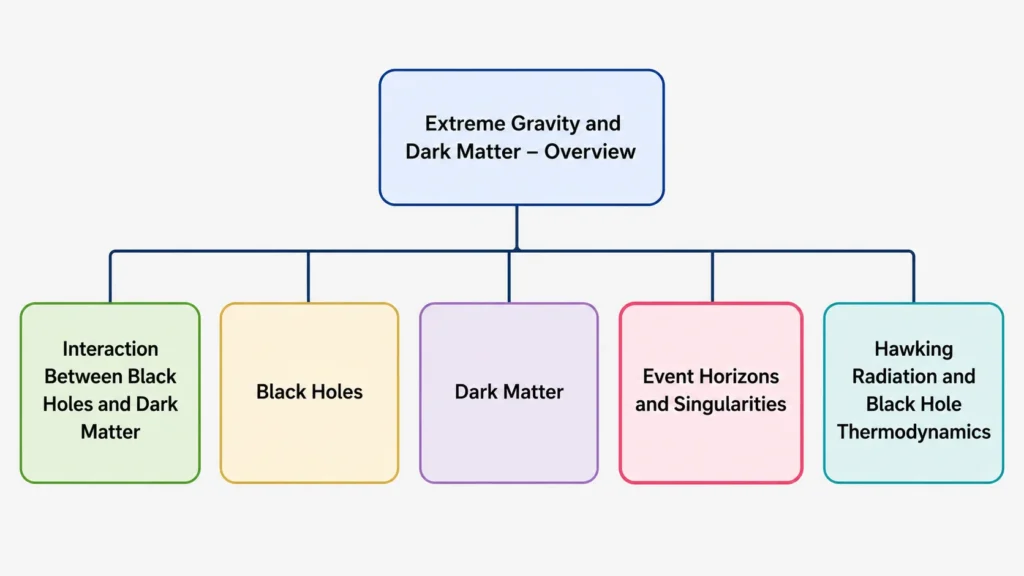
A simple hierarchy chart showing how Event Horizons and Singularities fits within the Extreme Gravity and Dark Matter cluster.
This diagram presents the Extreme Gravity and Dark Matter cluster as a simple hierarchical structure. Extreme Gravity and Dark Matter Overview appears as the parent page, connected to five terminal subpages: Interaction Between Black Holes and Dark Matter, Black Holes, Dark Matter, Event Horizons and Singularities, and Hawking Radiation and Black Hole Thermodynamics.
Event Horizon: The Point of No Return
An event horizon is the definitive one-way causal boundary around a black hole beyond which the escape velocity of mass-energy exceeds the vacuum speed of light (\(c\)). It is mathematically defined as the “point of no return,” tracking a global null hypersurface where light cones tilt completely inward, preventing light, matter, and causal information from escaping to the outside universe.
For an outside observer, the event horizon defines the absolute observable boundary of a compact system. An infalling particle crosses this boundary smoothly in its own local proper time frame, but general relativistic constraints dictate that no forward-directed light signal can cross back over this threshold to reach distant observers. Consequently, the event horizon serves as a perfect coordinate firewall separating the black hole’s hidden interior from the rest of space.
No Physical Surface
The event horizon possesses no material structure, shell, or physical surface. An astronaut falling through the horizon of a supermassive black hole would experience no localized physical impact or structural stress at the exact crossing point. The boundary is an architectural transition in spacetime geometry rather than a concrete wall.
A One-Way Causal Boundary
Outside the event horizon, a photon’s future light cone remains open enough to permit radial escape trajectories if directed outward. At the horizon, the outward-directed boundary of the light cone becomes parallel to the horizon itself. Inside it, the light cones tip over completely, meaning all future-directed geodesics lead deeper inward toward the center, making escape a geometric contradiction.
Gravitational Time Dilation
Strong gravitational potential fields profoundly modify the coordinate tracking of time. For a stationary observer at infinity, an object falling toward the event horizon appears to slow down exponentially, its clock freezing and its emission dimming via infinite gravitational redshift as it approaches \(R = R_s\). From the infalling object’s own co-moving reference frame, however, proper time ticks continuously and normally across the boundary.
Connection with Hawking Radiation
When quantum fields are evaluated against a curved spacetime background, the event horizon acts as an active thermodynamic interface. Semiclassical quantum fluctuations near the horizon result in the production of Hawking radiation, where one virtual particle state drops below the horizon while its partner escapes as thermal blackbody emission. This mechanics assigns a defined temperature, entropy, and long-term evaporation timeline to the horizon boundary.
Schwarzschild Radius
For a static, uncharged black hole, the geometric boundary of the event horizon is given precisely by the Schwarzschild radius:
$$R_s = \frac{2GM}{c^2}$$
Where \(R_s\) is the Schwarzschild radius, \(G\) is the Newtonian gravitational constant, \(M\) is the absolute mass of the black hole, and \(c\) is the vacuum speed of light. For a compact remnant holding one solar mass (\(1M_{\odot}\)), this metric evaluates to approximately 3 km, indicating the scale to which stellar mass must be compressed to initiate unhindered gravitational collapse.
Key takeaway: The event horizon is the practical boundary of a black hole: not a surface, but a spacetime limit beyond which escape is impossible.
Reflection: What Is the Real Boundary of a Black Hole?
Use this prompt to distinguish between an event horizon and a singularity.
Why is the event horizon usually treated as the practical boundary of a black hole, while the singularity is treated as a deeper theoretical problem?
Your thinking prompt: Think about escape, light signals, spacetime curvature, and the limits of classical general relativity.
Suggested reflection: The event horizon is the practical boundary because it marks the point beyond which light and information cannot escape to outside observers. The singularity is deeper inside the classical model, where spacetime curvature is predicted to become extreme and current theory breaks down. This makes the event horizon observationally meaningful and the singularity theoretically unresolved.
Singularity: Where Classical Physics Reaches Its Limit
In classical general relativity, a singularity is a mathematical coordinate region where the metric components diverge, causing spacetime curvature invariants and mass densities to yield infinite values. While introductory textbooks define this boundary limit as a literal point of infinite mass density, university-level physics treats a singularity as an explicit proof that classical relativity breaks down when evaluated at extreme energy scales. To resolve the physical state inside this boundary requires a finalized framework of quantum gravity capable of smoothing out infinite field values.
Why Singularities Are Difficult
General relativity dictates that mass-energy dictates the curvature of the spacetime metric. As infalling matter collapses past the horizon, all forward-directed geodesics converge, causing tidal forces to approach infinity. Under these conditions, the smooth geometric description of spacetime ceases to hold, indicating a fundamental boundary limit to classical descriptions of time and space.
Point Singularities
For an ideal, non-rotating, uncharged black hole—modeled via the static Schwarzschild metric—the field equations compress all infalling mass into a single spatial coordinate at the geometric center (\(R = 0\)). This mathematical limit is defined as a zero-dimensional point singularity.
Ring Singularities
For a realistic rotating black hole—modeled via the axisymmetrical Kerr metric—the inclusion of angular momentum (\(J\)) alters the internal gravitational collapse geometry. The singularity is stretched away from a point and mapped as a one-dimensional ring singularity situated within the inner horizon. While mathematical extensions of the Kerr metric suggest coordinate paths through the center of this ring leading to wormhole geometries, these scenarios are physically unstable and do not reflect confirmed astrophysical systems.
Charged Black Holes and Inner Horizons
Charged black hole configurations, such as the static Reissner-Nordström or rotating Kerr-Newman metrics, introduce complex internal coordinate layers including distinct inner Cauchy horizons. However, because surrounding cosmic environments are highly ionized, macroscopic black holes continuously accrete neutralizing plasma, ensuring that real-world stellar and supermassive black holes carry a negligible net electric charge (\(Q \approx 0\)).
Key takeaway: Singularities are important not because they are fully understood, but because they show where current physical theory becomes incomplete.
Schwarzschild Radius and the Size of an Event Horizon
The Schwarzschild radius gives the event horizon size for a simple non-rotating, uncharged black hole. It shows how the size of a black hole’s horizon depends on mass.
\(R_s = \frac{2GM}{c^2}\)
The formula tells us that a more massive black hole has a larger event horizon. If twice as much mass is compressed into a black hole, the Schwarzschild radius also doubles.
Examples of Schwarzschild Radii
Earth-Mass Black Hole
If Earth were compressed into a black hole, its Schwarzschild radius would be about 9 mm. Earth is not a black hole because its mass is spread over a much larger radius.
Sun-Mass Black Hole
A black hole with the mass of the Sun would have a Schwarzschild radius of about 3 km. The Sun itself is not a black hole because it is far larger than this radius.
Sagittarius A*
The supermassive black hole at the centre of the Milky Way has a Schwarzschild radius of roughly 12 million km, showing how event horizon size grows with mass.
Rotating Black Holes
Real astrophysical black holes are expected to rotate. A rotating black hole has a more complex structure than a simple Schwarzschild black hole. It may have an ergosphere, a region outside the event horizon where spacetime itself is dragged around by the black hole’s rotation.
The Schwarzschild radius is therefore best understood as the clean starting model. It is extremely useful for basic learning, but real black holes often require more advanced models.
Key takeaway: The Schwarzschild radius gives the simplest estimate of black hole size and shows that black hole horizons grow in proportion to mass.
The Newtonian Horizon Derivation Trap
When introducing the boundary limits of extreme gravity, instructors often point out a fascinating mathematical coincidence. If you apply classical Newtonian mechanics to calculate the radius at which the escape velocity of a mass equals the speed of light (\(c\)), you set the escape velocity equation directly to light speed:
$$c = \sqrt{\frac{2GM}{R}}$$
Algebraically isolating \(R\) yields a value that perfectly matches the general relativistic boundary:
$$R = \frac{2GM}{c^2}$$
For university-level physics students, it is vital to recognize that this Newtonian derivation is fundamentally flawed, despite yielding the correct geographic radius. In classical physics, light consists of massless corpuscles or waves. Because a Newtonian gravitational potential couples strictly to mass (\(m\)), setting a kinetic energy barrier for a massless photon is a conceptual contradiction.
Furthermore, in a Newtonian system, an object traveling at light speed could still cross the boundary, slow down, turn around at an apogee outside the radius, and escape back to infinity. An event horizon behaves entirely differently: it is a one-way causal boundary in spacetime geometry. Inside \(R_s\), the light cones tip over completely, swapping the spatial coordinate with the temporal coordinate. Escaping an event horizon is not difficult because you lack velocity; it is impossible because every future path points structurally toward the center.
Key takeaway: The Newtonian escape velocity formula matches the Schwarzschild radius by mathematical coincidence, but it fails to model the true general relativistic nature of an event horizon as a causal boundary.
Coordinate Singularities vs. Physical Singularities
When analyzing the geometry of a static black hole using the standard Schwarzschild metric, students encounter two distinct radial coordinates where the mathematical terms appear to break down by dividing by zero. The first occurs at the event horizon boundary (\(R = R_s\)), and the second occurs at the absolute geometric center (\(R = 0\)). For university-level physics, it is a critical requirement to differentiate between a coordinate singularity and a true physical singularity.
The breakdown at the event horizon (\(R = R_s\)) is purely a coordinate singularity. This means the mathematical infinity is an artifact of the specific coordinate system chosen to map the space, not a physical barrier. It is completely analogous to the North Pole on a standard flat Mercator projection map, where a single physical point is stretched into an infinitely long line. If an astronaut switches to a non-singular coordinate system—such as Eddington-Finkelstein or Kruskal-Szekeres coordinates—the infinity at the event horizon vanishes completely, proving that the local spacetime metric is smooth and continuous as an object crosses into the black hole.
Conversely, the breakdown at the center (\(R = 0\)) is an absolute, unavoidable physical singularity. No transformation of coordinate axes can eliminate this boundary limit. At this coordinate, invariant geometric terms—such as the Kretschmann scalar curvature (\(R^{\alpha\beta\gamma\delta}R_{\alpha\beta\gamma\delta}\))—diverge to true infinity. This indicates a genuine collapse of the physical fabric of spacetime where tidal forces become infinite and the geodesic worldlines of matter terminate.
Key takeaway: The event horizon is a coordinate singularity that can be cleared away with better mathematical maps, whereas the center is a physical singularity representing a true boundary limit of general relativity.
Theoretical Implications and Paradoxes
Event horizons and singularities transcend standard observational astronomy, presenting profound foundational crises regarding information conservation, micro-causality, deterministic prediction, and the structural limits of physical law.
The Black Hole Information Problem
A primary tension in modern fundamental physics exists between general relativity and quantum mechanics. The unitary evolution of quantum mechanics dictates that the total information state of a closed system must remain conserved over time (the preservation of probabilities). However, if baryonic matter falls past an event horizon and the system later undergoes complete thermal evaporation via semiclassical Hawking radiation, the escaping radiation tracks as mixed and thermalized, apparently erasing the microstate history of the initial infalling matter. This black hole information problem highlights a severe conceptual conflict at the intersection of curved spacetime metrics, statistical entropy, and quantum fields.
The Holographic Principle
To resolve the apparent loss of quantum state histories, theoretical physicists proposed that the full information content of an infalling three-dimensional physical volume is mapped onto the two-dimensional bounding surface of the event horizon. This framework directly inspired the holographic principle and the anti-de Sitter/conformal field theory (AdS/CFT) correspondence, suggesting that the volume description of a gravitational system can be modeled as a holographic projection from its lower-dimensional spatial boundaries.
Cosmic Censorship Hypotheses
Because physical singularities yield divergent infinities where deterministic differential equations lose predictive capacity, the cosmic censorship hypothesis—introduced by Roger Penrose—proposes that all singularities produced via realistic gravitational collapse must remain safely enveloped behind a one-way event horizon. If this rule holds (weak cosmic censorship), the external universe remains protected from exposed, “naked” singularities where classical causality and predictable spacetime paths break down.
Wormholes and Closed Timelike Curves
Extended mathematical analytical continuations of the Kerr and Einstein-Rosen metrics yield vacuum solutions that link separate regions of spacetime via localized Einstein-Rosen bridges, commonly classified as wormholes. While computationally fascinating, these coordinate paths require the injection of non-physical exotic matter possessing a negative stress-energy tensor to prevent immediate gravitational pinching and closure. Students must treat these constructs as geometric possibilities of the field equations rather than verified features of real astrophysical entities.
Key takeaway: Event horizons and singularities matter because they force physicists to ask whether information, prediction, and causality survive under extreme gravity.
Observational Evidence and Research
Because event horizons emit no independent baryonic light and internal physical singularities are causally disconnected from our universe, researchers rely on high-precision multi-messenger indirect detection to cross-examine horizon-scale spacetime geometries.
Event Horizon Telescope (EHT) Interferometry
Utilizing very-long-baseline interferometry (VLBI) to construct a synchronized Earth-sized radio telescope array, the Event Horizon Telescope resolved the first horizon-scale image of the supermassive black hole at the core of galaxy M87 in 2019. The configuration maps a localized lensed emission ring surrounding a dark central asymmetric feature termed the black hole shadow. This shadow provides direct empirical confirmation of light capture orbits and strong gravitational lensing close to the mathematical Schwarzschild boundary.
Spacetime Ripples and Gravitational Wave Events
Laser interferometers like LIGO, Virgo, and KAGRA capture transient gravitational wave signals produced during the inspiral and final merger events of binary black hole systems. By comparing the recorded waveform chirps against high-order numerical relativity models, physicists verify that the highly non-linear quasinormal ringdown phase tracks precisely as predicted by general relativistic perturbation theory, validating horizon parameters.
High-Energy Accretion Mechanics and Jets
Baryonic gas infalling toward an event horizon is accelerated to relativistic velocities, establishing a rotating accretion disk. Internal viscous friction converts this gravitational potential energy into superheated thermal radiation, releasing high-intensity X-ray fluxes. Concurrently, coupled magnetic field lines can launch highly collimated relativistic plasma jets perpendicular to the disk, tracing the compact object’s angular momentum profile across vast intergalactic scales.
Stellar Kinematics and Mass Tracking
By measuring the closed, high-velocity Keplerian orbital trajectories of visible stars (such as the S-stars orbiting Sagittarius A* at our galactic center), astronomers execute orbital mass derivations. Resolving several million solar masses enclosed within a spatial volume smaller than our inner solar system leaves a supermassive relativistic black hole configuration as the only physically stable configuration.
Key takeaway: Scientists study event horizons and singularities indirectly, using shadows, orbits, radiation, gravitational waves, and mathematical models.
Common Misconceptions about Event Horizons and Singularities
Misconception: The Event Horizon Is a Solid Surface
The event horizon represents a purely geometric causal boundary in the structural layout of spacetime, not a concrete material shell that generates impact forces or physical surface drag.
Misconception: A Falling Object Freezes in Its Own Time
While general relativistic time dilation makes an infalling particle appear to slow down and freeze at the horizon boundary from the perspective of an observer at infinity, the particle’s own proper time frame ticks continuously, passing the metric horizon within a finite time.
Misconception: We Fully Understand Singularities
Singularities are not localized physical points of material matter. They represent mathematical infinities indicating a boundary limit where the classical field definitions of general relativity fail, signaling the need for an upgraded theory of quantum gravity.
Misconception: Wormholes Are Confirmed Features of Black Holes
Though certain metrics allow for wormhole coordinate transformations, these configurations are highly unstable, require unverified negative energy densities to exist, and remain entirely theoretical.
Why Study Event Horizons and Singularities
Studying event horizons and singularities helps students understand the most extreme limits of black hole physics. These ideas show how gravity affects time, light, information, and the structure of spacetime itself.
Understanding Boundaries in Spacetime
The event horizon introduces students to the idea that a boundary can exist without being a material surface. It is a boundary created by the causal structure of spacetime.
Exploring the Limits of General Relativity
Singularities show where general relativity becomes incomplete. This helps students understand why new theories, such as quantum gravity, are needed.
Connecting Observation and Theory
Event horizons cannot be touched or seen directly, but their presence can be inferred through black hole shadows, accretion disks, gravitational waves, and stellar orbits.
Preparing for Advanced Physics
This topic builds conceptual foundations for general relativity, quantum gravity, black hole thermodynamics, cosmology, and advanced astrophysics.
Key takeaway: Event horizons and singularities are worth studying because they reveal where physics becomes both most powerful and most incomplete.
Frequently Asked Questions about Event Horizons and Singularities
What is an event horizon?
An event horizon is the non-singular mathematical boundary around a black hole defining the point of no causal return for matter and radiation, where the local escape velocity matches the speed of light.
Is the event horizon a solid surface?
No. The event horizon is not a physical surface or material shell. It is a boundary in spacetime geometry defined by the causal paths of light and information.
What is a singularity?
In classical general relativity, a singularity is a region where spacetime curvature invariants and mass densities diverge toward infinity, indicating that the equations of classical physics can no longer provide a complete physical description.
Do scientists know what happens at a singularity?
No. Singularities represent explicit limits where general relativity breaks down. A finalized theory of quantum gravity is required to smooth out these infinite mathematical divergences and describe the true physical state.
Can we see a singularity?
No. According to the cosmic censorship hypothesis, singularities formed via gravitational collapse are hidden behind an event horizon, preventing them from being observed directly from the outside universe.
What is the Schwarzschild radius?
The Schwarzschild radius defines the physical size of the event horizon for a non-rotating, uncharged black hole configuration, calculated exactly via the formula \(R_s = \frac{2GM}{c^2}\).
Why are event horizons important for Hawking radiation?
Hawking radiation occurs due to quantum field variations evaluated near the event horizon’s boundary, where virtual particle-antiparticle pairs are separated, converting vacuum energy into real thermal radiation.
Why are event horizons and singularities useful for students?
They expose students to the foundational boundaries of general relativity, black hole thermodynamics, and quantum gravity questions, building core data literacy and evidence-based analytical skills.
Conclusion
Event horizons and singularities lie at the heart of black hole physics. The event horizon marks the boundary beyond which escape becomes impossible, while the singularity marks a deeper theoretical limit where classical general relativity no longer gives a complete answer.
These concepts show how black holes are more than dark astronomical objects. They are places where gravity changes the structure of spacetime, where information becomes difficult to understand, and where the search for quantum gravity becomes unavoidable.
Modern observations, including black hole imaging, stellar orbits, X-ray emission, radio jets, and gravitational waves, continue to test ideas about horizon-scale gravity. Yet the singularity itself remains hidden and unresolved.
For students, the central lesson is clear: event horizons define the observable boundary of a black hole, while singularities reveal the edge of present-day physics.
Glossary of Key Terms
Event Horizon
The boundary around a black hole beyond which light, matter, and information cannot escape to the outside universe.
Singularity
A region in classical general relativity where spacetime curvature becomes extreme and the theory stops providing a complete physical description.
Schwarzschild Radius
The radius of the event horizon for a non-rotating, uncharged black hole, given by \(R_s = \frac{2GM}{c^2}\).
Spacetime Curvature
The bending of space and time caused by mass and energy. In general relativity, gravity is described as spacetime curvature.
Gravitational Time Dilation
The slowing of time in stronger gravitational fields as seen by distant observers.
Ergosphere
A region around a rotating black hole where spacetime is dragged by the black hole’s spin.
Kerr Black Hole
A rotating black hole described by the Kerr solution of general relativity.
Black Hole Shadow
The dark central region seen against glowing surrounding material, caused by light capture and gravitational bending near a black hole.
Cosmic Censorship
The hypothesis that singularities formed by gravitational collapse are hidden behind event horizons.
Holographic Principle
The idea that information within a region of space may be encoded on a boundary surface.
Quantum Gravity
A still-developing theoretical framework that aims to describe gravity using quantum principles.
Gravitational Wave
A ripple in spacetime produced by accelerating massive objects, such as merging black holes.
Comprehensive Problem Bank: Event Horizons and Singularities
Section A: Core Qualitative Review Questions
How does an event horizon differ fundamentally from a solid material boundary? Answer: An event horizon is a purely geometric threshold in spacetime rather than a physical shell. Local spacetime curvature remains smooth and regular at the boundary itself, meaning an infalling observer would cross into the interior without experiencing a localized structural impact. It is a boundary of causality and information pathing, not a concrete surface.
Why does a singularity imply that our current understanding of classical General Relativity is incomplete? Answer: Classical general relativity models a singularity as a region where field equations yield infinite values for mass density and spacetime curvature. Because physical infinities cannot be evaluated or managed within standard differential equations, they signal a breakdown where the smooth geometric rules of classical physics fail, indicating that a finalized, non-divergent framework of quantum gravity must replace the metric at these extreme scales.
What is the physical meaning of a coordinate singularity compared to a true physical singularity? Answer: A coordinate singularity—such as the one at the Schwarzschild event horizon (\(R = R_s\))—is an artifact of the chosen map coordinate grid and can be mathematically eliminated by switching to a non-singular coordinate framework (e.g., Kruskal-Szekeres coordinates). A true physical singularity—such as the one at the geometric center (\(R = 0\))—cannot be transformed away; it features infinite geometric invariants and marks an absolute physical breakdown of the spacetime fabric.
How does the cosmic censorship hypothesis safeguard the predictable nature of our universe? Answer: The weak cosmic censorship hypothesis proposes that all singularities resulting from realistic gravitational collapse must be shielded from the outside universe by a stable event horizon. By trapping the singularity behind a one-way causal boundary, it ensures that the mathematical unpredictability and breakdown of determinism at the singularity cannot affect observers in external spacetime.
Section B: Conceptual and Foundational Proofs
Why is the classical Newtonian derivation of the Schwarzschild radius conceptually flawed despite giving the correct algebraic result? Answer: The Newtonian calculation sets a kinetic-to-potential energy equivalence using a massive test particle and assumes photons are corpuscles affected by Newtonian potentials. Photons are fundamentally massless, and a true event horizon is not a place where particles slow down due to a drag force; it is a region where the light cones of spacetime tilt entirely inward, making any outward path geometrically impossible regardless of velocity.
Analyze how the black hole information paradox threatens the foundational tenets of quantum mechanics. Answer: Quantum mechanics relies on the principle of unitarity, which dictates that the complete state history (quantum information) of a closed system must always be preserved. Semiclassical Hawking radiation, however, is purely thermal and uncorrelated; if a black hole evaporates completely, the microstate information of the infalling matter is apparently lost to the universe, which directly violates the conservation of quantum probabilities.
How does the holographic principle provide a potential resolution to information loss at a singularity? Answer: The holographic principle suggests that the absolute information content inside a physical volume can be entirely encoded onto its lower-dimensional bounding surface. In a black hole system, information carried by infalling matter is projected onto the two-dimensional surface area of the event horizon rather than falling to the central singularity, allowing the information to be preserved and encoded within outbound Hawking radiation as the black hole evaporates.
1. Schwarzschild Horizon Radius Calculations for Stellar Remnants
Calculate the exact Schwarzschild horizon radius (\(R_s\)) of a massive stellar-remnant black hole holding an absolute mass profile of \(M = 5.0 \times 10^{30}\,\text{kg}\).
Click to expand solution
Apply the classical Schwarzschild radius boundary metric:
$$R_s = \frac{2GM}{c^2}$$
Substitute the given physical constants directly into the expression:
$$R_s = \frac{2 \times (6.674 \times 10^{-11}\,\text{m}^3\text{kg}^{-1}\text{s}^{-2}) \times (5.0 \times 10^{30}\,\text{kg})}{(2.998 \times 10^8\,\text{m/s})^2}$$
$$R_s = \frac{6.674 \times 10^{20}}{8.988 \times 10^{16}} \approx 7425.5\,\text{meters}$$
The mathematical boundary radius defining the event horizon of this system is approximately \(7.43 \times 10^3\,\text{m}\) (or \(7.43\,\text{km}\)).
2. Causal Boundary Velocity Limits via Field Derivations
Determine the analytical radius at which the escape velocity parameter of a static mass envelope matches the vacuum speed of light.
Click to expand solution
Set the standard escape velocity configuration directly equal to light speed \(c\):
$$v_{\text{esc}} = \sqrt{\frac{2GM}{r}} \quad \rightarrow \quad c = \sqrt{\frac{2GM}{r}}$$
Square both sides of the balanced equation to isolate the spatial coordinate \(r\):
$$c^2 = \frac{2GM}{r} \quad \rightarrow \quad r = \frac{2GM}{c^2}$$
This confirms that the physical coordinate at which escape velocity matches the speed of light maps directly onto the Schwarzschild horizon radius.
3. Relativistic Gravitational Time Dilation Coordinates
A localized coordinate system experiences severe gravitational time dilation near a black hole horizon boundary. If a stationary sensor platform is positioned at an altitude coordinate of \(R = 1.25 R_s\), evaluate its exact proper time dilation factor relative to a distant clock.
Click to expand solution
Apply the general relativistic Schwarzschild metric proper time transformation formula:
$$t' = t\sqrt{1 - \frac{R_s}{R}}$$
Substitute the targeted location parameter (\(R = 1.25 R_s\)) into the radical term:
$$t' = t\sqrt{1 - \frac{R_s}{1.25 R_s}} = t\sqrt{1 - \frac{1}{1.25}} = t\sqrt{1 - 0.8} = t\sqrt{0.2}$$
$$t' \approx 0.4472 \cdot t$$
The time dilution coefficient evaluates to approximately \(0.447\), meaning the horizon-adjacent clock ticks at roughly \(44.7\%\) the rate of a deep-space benchmark clock.
Compute the precise gravitational redshift factor (\(z\)) recorded by an outside observer analyzing radiation emitted from an astronomical platform resting at a physical coordinate of \(R = 2 R_s\).
Click to expand solution
Apply the standard gravitational redshift metric equation:
$$z = \frac{1}{\sqrt{1 - \frac{R_s}{R}}} - 1$$
Substitute the exact coordinate value (\(R = 2R_s\)) into the functional variable:
$$z = \frac{1}{\sqrt{1 - \frac{R_s}{2R_s}}} - 1 = \frac{1}{\sqrt{1 - 0.5}} - 1 = \frac{1}{\sqrt{0.5}} - 1$$
$$z = \frac{1}{0.7071} - 1 \approx 1.4142 - 1 = 0.4142$$
Photons climbing out from this coordinate point undergo a metric gravitational redshift transformation of approximately \(0.414\).
5. Enclosed Mass Restructuring from Horizon Area Parameters
An isolated compact object presents a calculated metric Schwarzschild radius parameter measuring exactly \(3.0\,\text{km}\) (\(3.0 \times 10^3\,\text{m}\)). Determine the absolute enclosed mass (\(M\)) responsible for this geometry.
Click to expand solution
Rearrange the Schwarzschild boundary metric to isolate the mass variable \(M\):
$$R_s = \frac{2GM}{c^2} \quad \rightarrow \quad M = \frac{R_s c^2}{2G}$$
Substitute the values into the reworked equation:
$$M = \frac{(3.0 \times 10^3\,\text{m}) \times (2.998 \times 10^8\,\text{m/s})^2}{2 \times (6.674 \times 10^{-11}\,\text{m}^3\text{kg}^{-1}\text{s}^{-2})}$$
$$M = \frac{3.0 \times 10^3 \times (8.988 \times 10^{16})}{1.3348 \times 10^{-10}} = \frac{2.6964 \times 10^{20}}{1.3348 \times 10^{-10}} \approx 2.020 \times 10^{30}\,\text{kilograms}$$
The compact object requires an integrated mass profile of approximately \(2.02 \times 10^{30}\,\text{kg}\) (roughly equivalent to \(1.02 M_{\odot}\)).
6. Localized Gravitational Acceleration Profiles at the Metric Boundary
Evaluate the local gravitational acceleration field strength (\(g\)) acting at the event horizon boundary of a non-rotating compact black hole whose total mass is fixed at \(M = 2.0 \times 10^{30}\,\text{kg}\). Use the relative acceleration metric \(g = \frac{GM}{R_s^2}\).
Click to expand solution
First, compute the companion Schwarzschild radius baseline for a \(2.0 \times 10^{30}\,\text{kg}\) stellar object:
$$R_s = \frac{2 \times (6.674 \times 10^{-11}) \times (2.0 \times 10^{30})}{(2.998 \times 10^8)^2} \approx 2969.95\,\text{meters}$$
Now, process the calculated boundary distance directly through the Newtonian-limit acceleration equation:
$$g = \frac{(6.674 \times 10^{-11}\,\text{m}^3\text{kg}^{-1}\text{s}^{-2}) \times (2.0 \times 10^{30}\,\text{kg})}{(2969.95\,\text{m})^2}$$
$$g = \frac{1.3348 \times 10^{20}}{8.8206 \times 10^6} \approx 1.513 \times 10^{13}\,\text{m/s}^2$$
The local boundary acceleration strength maps out an intense field of approximately \(1.51 \times 10^{13}\,\text{m/s}^2\).