
Extreme Gravity and Dark Matter explores the physical mechanisms and mathematical modeling of the most intense gravitational fields and non-luminous mass distributions in the cosmos. This cluster unifies the relativistic mechanics of black holes, spacetime singularities, event horizons, Hawking radiation, black hole thermodynamics, non-baryonic dark matter, and the deep dynamical interactions between compact stellar remnants and surrounding dark matter halos.
Black holes represent the absolute limit solutions of Einstein’s field equations. They materialize when a localized mass undergoes unhindered gravitational collapse, compressing matter beyond its unique critical boundary—the Schwarzschild radius (\(R_s = \frac{2GM}{c^2}\)). This boundary establishes an isotropic, non-singular mathematical envelope known as the event horizon, separating trapped interior spacetime paths from the external universe. Analyzing these horizons challenges students to evaluate the breakdown of classical field models under the infinite curvature profiles of mathematical singularities.
The cluster also introduces the semiclassical quantum behaviors of compact objects. The integration of quantum field theory in curved spacetimes dictates that black holes are not completely static traps. Through Hawking radiation and black hole thermodynamics, these entities are treated as open physical systems possessing defined thermal blackbody spectra, macroscopic entropy profiles, and information conservation properties. This framework sits at the fundamental boundary where general relativity, thermodynamics, and quantum mechanics meet.
Dark matter presents a different kind of mystery, tracked via its massive gravitational footprint rather than baryonic emission. It does not interact with the electromagnetic spectrum, making it completely invisible to direct photon detection. Instead, its presence is mathematically derived from the flat profiles of galactic rotation curves, weak gravitational lensing shear, and massive galaxy cluster stability mechanics. This missing mass distribution links this cluster directly to modern evolutionary cosmology.
Investigating the interaction between black holes and dark matter brings together two dominant unknowns in astrophysics: point-like singularities of extreme gravity and diffuse halos of unseen mass. Modeling how supermassive black holes ingest cold dark matter provides vital data for tracing galactic core evolution, stellar kinematics, and the macroscale mass distribution of our universe.
For university-bound physics students, the primary lesson is clear: extreme gravity and dark matter highlight the precise horizons where current physical laws face their greatest tests. This cluster demonstrates how multi-messenger observation, field mathematics, and rigorous theoretical frameworks operate at the cutting edge of contemporary astrophysics.
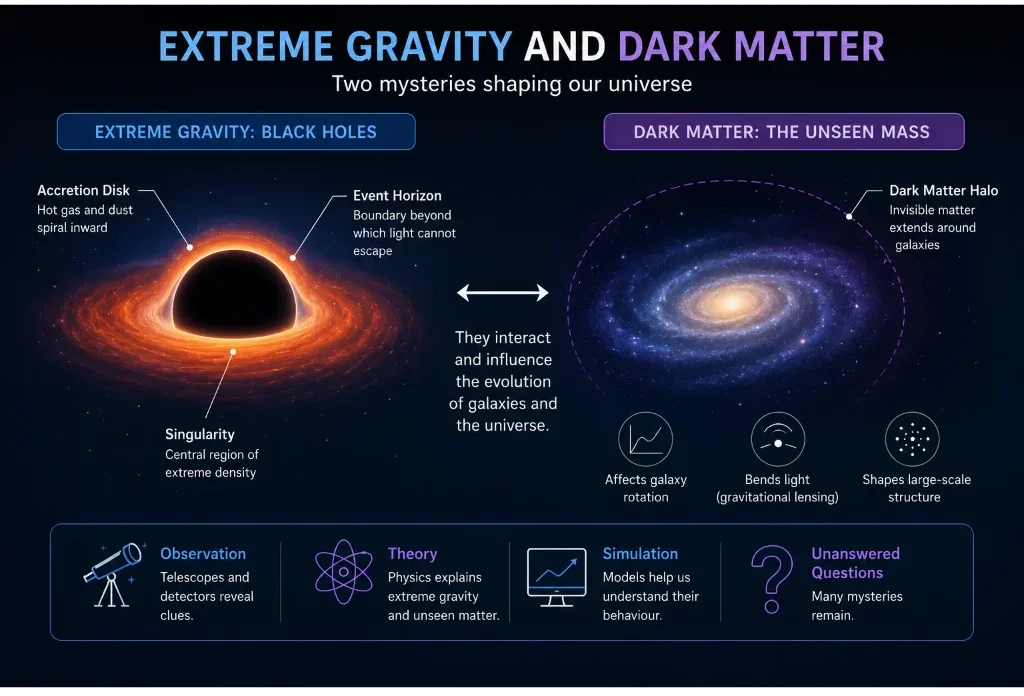
This illustration introduces the Extreme Gravity and Dark Matter cluster. It contrasts black holes, where gravity becomes extremely strong near event horizons and singularities, with dark matter, an unseen form of mass detected through its gravitational effects on galaxy rotation, gravitational lensing, and large-scale structure.
What Connects Extreme Gravity and Dark Matter?
Extreme gravity and dark matter may seem like separate topics, but they are connected by one central idea: gravity reveals what light cannot always show. Black holes are difficult to observe directly because light cannot escape from inside the event horizon. Dark matter is difficult to observe because it does not emit, absorb, or reflect light. Yet both can be studied through their gravitational effects.
Black holes reveal gravity at its most concentrated and intense. They help scientists examine spacetime curvature, event horizons, singularities, accretion disks, gravitational waves, and the possible links between gravity and quantum theory. Dark matter reveals gravity at a much larger scale, shaping galaxy rotation, galaxy clusters, gravitational lensing, and the cosmic web.
Together, these topics show how modern astrophysics often works through indirect evidence. Scientists may not always see the object itself, but they can measure how it affects stars, gas, light, spacetime, and galaxy structure.
Key takeaway: Extreme gravity and dark matter are connected because both teach students how gravity can expose hidden parts of the universe.
Spacetime Singularity Dynamics and Luminous Deviations
Reconciling point-like gravitational singularities with expansive, diffuse mass distributions requires a deep shift in how structural physics treats mass configurations. Within highly dense relativistic fields, gravitational tracking must account for tensor transformations that do not rely on luminous matter variables. While baryonic matter interacts readily with the cosmic photon field, non-baryonic mass structures display spatial flat configurations across wide galactic margins. This behavior suggests that modern cosmic modeling cannot rely solely on classical optical tracking. Instead, the mathematical integration of gravitational velocity potentials over large scale profiles reveals that empty space possesses deep kinematic properties. For undergraduate students, analyzing this unseen architecture highlights the limits of geometric relativity when confronted with hidden mass-energy distributions across the galactic horizon.
Extreme Gravity, Invisible Mass, and Cosmic Architecture
This hub explores how extreme gravitational systems and unseen matter shape the structure of the universe, linking astrophysics, compact objects, invisible mass, and large-scale cosmic dynamics.
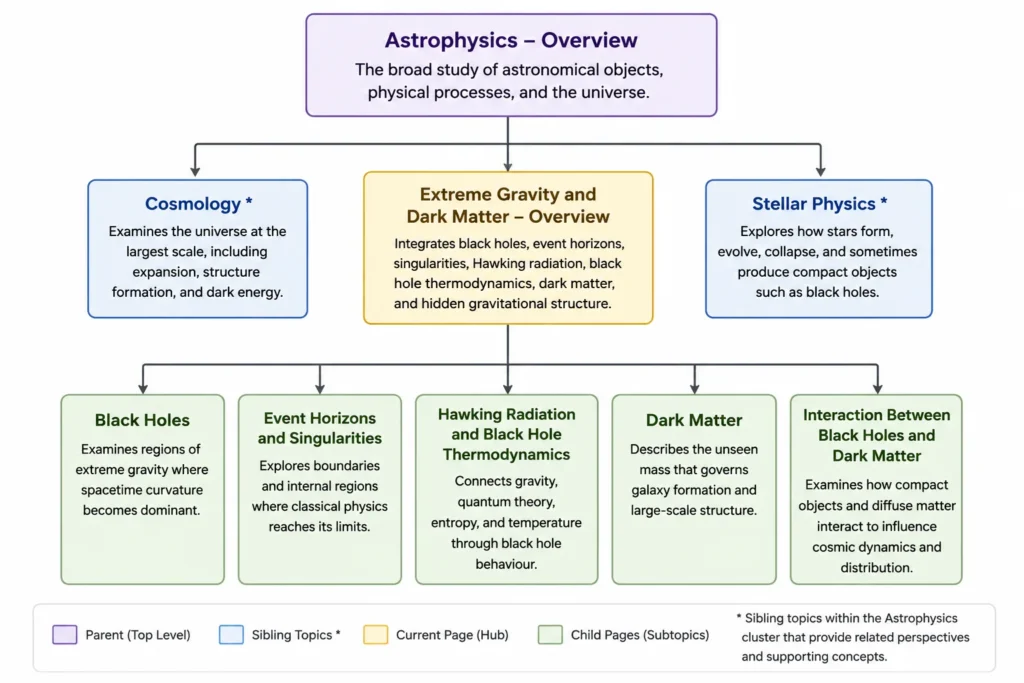
This diagram presents the Extreme Gravity and Dark Matter cluster as part of the wider Astrophysics section. Astrophysics Overview appears at the top, with Cosmology and Stellar Physics shown as sibling topics.
Astrophysics – Overview
Frames this cluster within the wider study of stars, galaxies, compact objects, dark matter, cosmic structure, and physical laws across the universe.* Cosmology
Examines the universe at the largest scale, including expansion, structure formation, dark energy, and the long-term evolution of cosmic systems.* Stellar Physics
Explores how stars form, evolve, collapse, enrich the universe, and sometimes produce compact objects such as black holes.Extreme Gravity and Dark Matter – Overview
Integrates black holes, event horizons, singularities, Hawking radiation, black hole thermodynamics, dark matter, and hidden gravitational structure into one connected cluster.Black Holes
Examines regions of extreme gravity where spacetime curvature becomes dominant and light cannot escape from within the event horizon.Event Horizons and Singularities
Explores the boundary of a black hole and the extreme internal conditions where classical physics reaches its limits.Hawking Radiation and Black Hole Thermodynamics
Connects gravity, quantum theory, entropy, temperature, and information through the strange behaviour of black holes.Dark Matter
Describes the unseen mass whose gravitational influence shapes galaxy rotation, galaxy clusters, gravitational lensing, and large-scale structure.Interaction Between Black Holes and Dark Matter
Examines how compact objects and diffuse dark matter may interact to influence galaxy evolution, mass distribution, and cosmic dynamics.* Sibling topics within the Astrophysics cluster that provide related perspectives and supporting concepts.
Applications of Extreme Gravity and Dark Matter
Extreme gravity and dark matter play a central role in modern astrophysics. They help scientists understand how galaxies form, how invisible mass shapes the universe, how black holes test the limits of physics, and how observation can reveal what cannot be seen directly.
Mapping Cosmic Structure
Dark matter provides much of the hidden gravitational framework behind galaxies, galaxy clusters, filaments, and the cosmic web. This links the topic closely to large-scale structure in cosmology.Studying Black Holes as Natural Laboratories
Black holes allow scientists to study gravity under extreme conditions, where spacetime curvature becomes intense and ordinary intuition breaks down. This connects directly to black holes and event horizons and singularities.Testing the Limits of Physical Theory
Extreme gravity raises deep questions about how general relativity, quantum theory, thermodynamics, and information theory fit together. Ideas such as Hawking radiation show why black holes are theoretical testing grounds.Improving Observational Methods
Because black holes and dark matter cannot always be seen directly, their study drives the development of indirect detection methods, including gravitational lensing, galaxy rotation measurements, and X-ray astronomy.Explaining Galaxy Formation
Dark matter helps explain why galaxies form where they do and why their visible matter behaves as observed. It provides the gravitational scaffolding in which gas collects, stars form, and galaxies evolve.Modelling Hidden Cosmic Systems
Scientists use simulations, statistical modelling, and large astronomical datasets to infer the behaviour of unseen matter and extreme gravitational systems, connecting astrophysics with computing.Why Study Extreme Gravity and Dark Matter
Studying extreme gravity and dark matter introduces students to some of the deepest mysteries in modern astrophysics. These topics show how scientists reason about objects and substances that cannot always be observed directly, using evidence from gravity, light, motion, radiation, simulations, and large-scale cosmic structure.
Exploring the Invisible Universe
Encourages students to study phenomena that reveal themselves indirectly, such as dark matter through galaxy rotation and black holes through accretion disks, stellar orbits, gravitational waves, and lensing.Understanding Gravity at Its Limits
Shows how gravity behaves under extreme conditions, especially near black holes, event horizons, and regions where spacetime curvature becomes very strong.Connecting Relativity and Quantum Theory
Introduces frontier questions where general relativity, quantum theory, thermodynamics, and information theory meet, especially through ideas such as Hawking radiation and black hole entropy.Linking Astrophysics and Cosmology
Connects astrophysics, cosmology, stellar evolution, galaxy formation, dark matter halos, and large-scale cosmic structure.Developing Evidence-Based Reasoning
Builds the ability to interpret indirect evidence, compare models, evaluate uncertainty, and reason from effects to hidden causes.Working with Modern Observational Data
Introduces data from telescopes, gravitational wave detectors, galaxy surveys, X-ray observations, radio imaging, and gravitational lensing studies.Using Simulations and Data Science
Develops skills in computational modelling, numerical simulation, statistical analysis, and large-scale data interpretation used in modern astrophysics.Preparing for Advanced Study
Provides a strong foundation for university-level work in physics, astronomy, astrophysics, cosmology, engineering, computation, and data science.Engaging with Big Scientific Questions
Invites students to explore fundamental questions about unseen matter, spacetime, singularities, black hole information, cosmic structure, and the limits of current physical laws.Reflection: Why Study What We Cannot Directly See?
Use this prompt to connect invisible matter, extreme gravity, and scientific reasoning.
Why is the study of black holes and dark matter valuable even though they are difficult or impossible to observe directly?
Your thinking prompt: Think about indirect evidence, galaxy rotation, gravitational lensing, accretion disks, stellar motion, gravitational waves, and the limits of physical theory.
Suggested reflection: Black holes and dark matter are valuable to study because their effects can be measured even when they cannot be seen directly. Dark matter reveals itself through gravity, galaxy rotation, lensing, and cosmic structure. Black holes reveal themselves through nearby matter, radiation, stellar orbits, jets, and gravitational waves. Together, they teach students how scientists use evidence to understand hidden parts of the universe.
Frequently Asked Questions about Extreme Gravity and Dark Matter
What does Extreme Gravity and Dark Matter study?
Extreme Gravity and Dark Matter studies some of the most mysterious gravitational phenomena in astrophysics. It includes black holes, event horizons, singularities, Hawking radiation, black hole thermodynamics, dark matter, and the possible interaction between compact objects and unseen mass.What is a black hole?
A black hole is a region of space where gravity is so strong that nothing can escape once it crosses the event horizon. Black holes may form from the collapse of massive stars, the merging of compact objects, or growth over long periods in the centres of galaxies.What are event horizons and singularities?
An event horizon is the boundary around a black hole beyond which light cannot escape. A singularity is the extreme central region predicted by classical theory, where density and spacetime curvature become so intense that current physical models reach their limits.What is dark matter?
Dark matter is an unseen form of matter that does not emit, absorb, or reflect light. Scientists infer its existence from gravitational effects such as galaxy rotation curves, gravitational lensing, galaxy cluster behaviour, and the formation of large-scale cosmic structure.Summary
Extreme Gravity and Dark Matter brings together some of the most mysterious gravitational phenomena in modern astrophysics. Black holes reveal how spacetime behaves under extreme conditions, while dark matter provides the unseen gravitational framework that helps shape galaxies, clusters, and large-scale cosmic structure.
This field remains central to unanswered questions about matter, gravity, spacetime, black hole information, galaxy formation, and the structure of the universe itself.
Glossary of Key Extreme Gravity and Dark Matter Terms
This glossary explains important terms used across the Extreme Gravity and Dark Matter cluster. These terms help students understand black holes, event horizons, singularities, Hawking radiation, dark matter, gravitational evidence, and the hidden structure of the universe.
- Extreme Gravity
- Gravity under conditions far stronger than those normally experienced near planets or ordinary stars. Black holes are among the clearest examples because spacetime becomes highly curved near them.
- Black Hole
- A compact region of space where gravity is so strong that nothing can escape once it passes the event horizon. Black holes can be detected indirectly through their effects on nearby matter, light, and spacetime.
- Event Horizon
- The boundary around a black hole beyond which escape is impossible. It is not a solid surface, but a point of no return for light and matter.
- Singularity
- A region predicted by classical theory where density and spacetime curvature become extreme. In modern physics, a singularity often signals that current theories are incomplete and that quantum gravity may be needed.
- Hawking Radiation
- A theoretical form of radiation predicted to be emitted by black holes due to quantum effects near the event horizon. It connects black hole physics with temperature, entropy, and quantum theory.
External References
The following references provide reliable background reading on black holes, dark matter, gravitational waves, and direct imaging of black hole environments.
Review Questions and Answers
- What does Extreme Gravity and Dark Matter study?Answer: It studies powerful gravitational phenomena and unseen mass in the universe, including black holes, event horizons, singularities, Hawking radiation, black hole thermodynamics, dark matter, and the possible interaction between black holes and dark matter.
- What is an event horizon?Answer: An event horizon is the boundary around a black hole beyond which escape is impossible. It is not a solid surface, but a point of no return for light and matter.
- What is a singularity?Answer: A singularity is a region predicted by classical theory where density and spacetime curvature become extreme. In modern physics, it usually signals that current theories are incomplete and that quantum gravity may be needed.
- What is dark matter?Answer: Dark matter is an unseen form of matter that does not emit, absorb, or reflect light. Its existence is inferred from gravitational effects on galaxy rotation, gravitational lensing, galaxy clusters, and the cosmic web.
Thought-Provoking Questions and Answers
- If black holes cannot be seen directly, why can scientists still be confident that they exist?Answer: Scientists do not need to see an object directly to infer its existence. Black holes reveal themselves through their effects on surrounding matter and spacetime, such as stellar orbits, accretion disks, jets, X-rays, and gravitational waves.
- Why do singularities suggest that current physics is incomplete?Answer: Singularities appear when classical equations are pushed to extremes. If a theory predicts infinite density or curvature, it may mean that a deeper theory, such as quantum gravity, is needed.
- Why is Hawking radiation important even though it has not been directly observed from astrophysical black holes?Answer: Hawking radiation is important because it links gravity, quantum theory, thermodynamics, and information. It shows that black holes are not only gravitational objects, but also theoretical laboratories for fundamental physics.
Comprehensive 6-Problem End-of-Chapter Bank
Quantitative Orbital and Metric Problems
Core Physical Constants:
Newtonian Gravitational Constant: \(G = 6.674 \times 10^{-11}\,\text{m}^3\text{kg}^{-1}\text{s}^{-2}\)
Vacuum Speed of Light: \(c = 2.998 \times 10^8\,\text{m/s}\)
Solar Mass Baseline: \(M_{\odot} \approx 1.989 \times 10^{30}\,\text{kg}\)
1. Schwarzschild Radius Derivation for Solar Mass Equivalents
Calculate the theoretical Schwarzschild radius (\(r_s\)) of our Sun if its entire mass profile were suddenly compressed to initiate an absolute gravitational collapse phase.
Click to expand solution
Apply the classical Schwarzschild boundary equation:
$$r_s = \frac{2GM}{c^2}$$
Substitute the given stellar constants into the boundary model:
$$r_s = \frac{2 \times (6.674 \times 10^{-11}\,\text{m}^3\text{kg}^{-1}\text{s}^{-2}) \times (1.989 \times 10^{30}\,\text{kg})}{(2.998 \times 10^8\,\text{m/s})^2}$$
$$r_s = \frac{2.6549 \times 10^{20}}{8.9880 \times 10^{16}} \approx 2953.8\,\text{meters}$$
If compressed below its critical boundary, a one-solar-mass object maps a Schwarzschild radius threshold of approximately \(2.95\,\text{km}\).
2. Linear Scaling Constraints of Intermediate Black Hole Horizons
Using the proportional baseline derived in the previous problem, estimate the exact event horizon Schwarzschild radius (\(r_s\)) of a stellar-mass black hole measuring exactly \(10 M_{\odot}\).
Click to expand solution
Because the Schwarzschild radius scales linearly with mass (\(r_s \propto M\)), the metric boundary for an upgraded mass profile can be evaluated via direct multiplication:
$$r_{s(10)} = 10 \times r_{s(1)} = 10 \times 2.954\,\text{km} = 29.54\,\text{km}$$
The structural horizon boundary parameter for a \(10 M_{\odot}\) system is exactly \(29.54\,\text{km}\).
3. Integrated Mass Extraction from Central Galactic Stellar Kinematics
An observational tracking team maps a test star executing a circular orbit around an invisible galactic core structure. The star maintains a stable orbital velocity of \(v = 2.0 \times 10^5\,\text{m/s}\) at a radial distance coordinate of \(r = 5.0 \times 10^{20}\,\text{m}\). Compute the total integrated mass (\(M\)) enclosed within this orbital framework.
Click to expand solution
Isolate the interior mass variable \(M\) from the standard circular velocity vector equation (\(v = \sqrt{\frac{GM}{r}}\)):
$$M = \frac{v^2 r}{G}$$
Substitute the recorded kinematic values into the balanced equation:
$$M = \frac{(2.0 \times 10^5\,\text{m/s})^2 \times (5.0 \times 10^{20}\,\text{m})}{6.674 \times 10^{-11}\,\text{m}^3\text{kg}^{-1}\text{s}^{-2}}$$
$$M = \frac{(4.0 \times 10^{10}) \times (5.0 \times 10^{20})}{6.674 \times 10^{-11}} = \frac{2.0 \times 10^{31}}{6.674 \times 10^{-11}} \approx 2.996 \times 10^{41}\,\text{kilograms}$$
The total mass enclosed within the orbital radius parameter is approximately \(3.00 \times 10^{41}\,\text{kg}\).
4. Astrophysical Conversion Factors targeting Solar Standards
Convert the absolute integrated galactic mass calculated in the previous problem (\(3.00 \times 10^{41}\,\text{kg}\)) into standard astronomical solar mass units (\(M_{\odot}\)).
Click to expand solution
Divide the absolute mass value by the solar mass constant baseline:
$$\text{Mass in } M_{\odot} = \frac{2.996 \times 10^{41}\,\text{kg}}{1.989 \times 10^{30}\,\text{kg}/M_{\odot}} \approx 1.506 \times 10^{11}\,M_{\odot}$$
The calculated galactic interior core envelope corresponds to approximately \(1.51 \times 10^{11}\) solar masses.
5. Gravitational Proofs of Missing Mass Profiles inside Non-Newtonian Velocities
An outer star situated at a vast radial distance from its galactic center tracks an orbital velocity of \(v = 220\,\text{km/s}\). A secondary star located even further out along the extreme edge of the system maps an identical velocity parameter of \(v = 220\,\text{km/s}\). Explain analytically why this flat velocity profile contradicts Keplerian laws and state what it implies.
Click to expand solution
According to Keplerian mechanics, if galactic mass were traced solely by visible luminous matter concentrated near the core, orbital velocities at large distances should fall off inversely with the square root of the radius (\(v \propto \frac{1}{\sqrt{r}}\)). Recording a flat velocity profile (\(v \approx \text{constant}\)) as the radius increases requires the enclosed mass expression (\(M(r) \propto r\)) to grow linearly with distance. Because the visible light profile drops off rapidly in these outer zones, this rising mass vector proves the existence of a massive, non-luminous dark matter halo enveloping the galaxy.
6. Non-Baryonic Fractions within Coupled Dynamical Subsystems
A massive spiral galaxy tracks a total kinematic mass profile of \(M_{\text{total}} = 2.0 \times 10^{11}\,M_{\odot}\) across its outer edge boundary. If high-resolution photon counting tracks the total visible baryonic component at only \(M_{\text{visible}} = 4.0 \times 10^{10}\,M_{\odot}\), compute the absolute mass of the non-baryonic dark matter halo.
Click to expand solution
Isolate the dark matter component by subtracting the visible baryonic mass from the total kinematic mass profile:
$$M_{\text{dark}} = M_{\text{total}} – M_{\text{visible}}$$
Substitute the solar mass parameters:
$$M_{\text{dark}} = (2.0 \times 10^{11}\,M_{\odot}) – (4.0 \times 10^{10}\,M_{\odot}) = 1.6 \times 10^{11}\,M_{\odot}$$
The absolute mass of the non-baryonic dark matter halo stabilizing the galaxy is exactly \(1.6 \times 10^{11}\,M_{\odot}\) (representing \(80\%\) of the total cosmic structure inventory).