Linguistics is the systematic study of human language – how it is structured, how it is used, how it changes over time, and how it is processed by the mind and brain. Rather than focusing on any one language, linguists look for underlying patterns that explain why languages around the world are both strikingly different and surprisingly similar.
At its core, linguistics asks questions such as: How do sounds combine to form words? How do words build into sentences? How do children acquire a language so quickly, and why do adults struggle with new ones? What happens when languages come into contact, or when they are endangered and disappear? By analysing real data – from everyday conversations and literary texts to social media posts and speech recordings – linguistics connects the “science of language” with broader issues in society, culture, technology, and education.
For students preparing for university, linguistics provides a bridge between the humanities, the social sciences, and STEM. It draws on logic and formal analysis, but also on history, psychology, anthropology, computer science, and philosophy. Whether you are interested in language teaching, translation, speech therapy, law, artificial intelligence, or literary studies, a grounding in linguistics helps you read texts more precisely, listen more carefully, and think more critically about how language shapes human experience.

A vibrant, semi-abstract illustration representing the field of linguistics. On the left, a human head in profile releases flowing sound waves that transform into different writing systems and symbols as they move across the image. Along the arc are small icons suggesting subfields such as phonetics (waveform and ear), syntax and morphology (puzzle-like word pieces), semantics and pragmatics (overlapping chat bubbles), psycholinguistics (a glowing brain outline with network lines), and sociolinguistics (a globe with multicoloured speech bubbles). The artwork uses rich blues, purples, and warm oranges on a light background to convey the idea that linguistics connects language, thought, culture, and technology.
Table of Contents
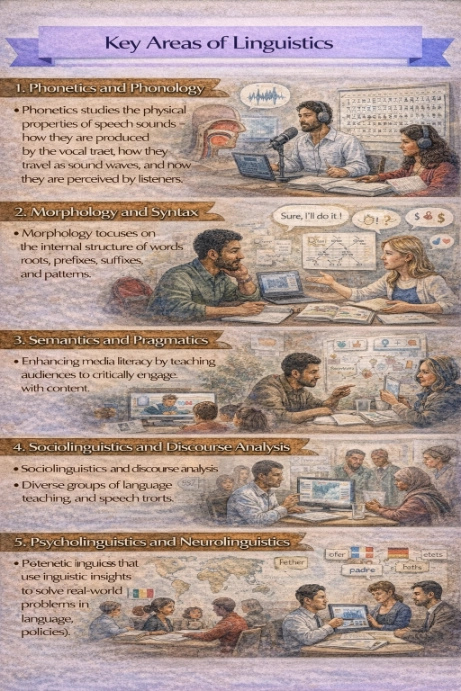
Key Areas of Linguistics
Linguistics is not one single subject, but a family of connected areas that look at language from different angles. As you move toward university-level study, it is helpful to recognise these core branches and how they fit together.
1. Phonetics and Phonology
Phonetics studies the physical properties of speech sounds – how they are produced by the vocal tract, how they travel as sound waves, and how they are perceived by listeners. You might learn to use the International Phonetic Alphabet (IPA) to represent sounds precisely.
Phonology looks at how sounds are organised in a particular language or across languages. It asks questions such as: Which sound contrasts matter for meaning? Why are some sound combinations possible but others not? Together, phonetics and phonology provide a foundation for fields like speech therapy, language teaching, and speech technology.
2. Morphology and Syntax
Morphology focuses on the internal structure of words: roots, prefixes, suffixes, and patterns such as plural formation or verb conjugation. It explains why “unhappiness” can be broken into meaningful parts, while other sequences of letters cannot.
Syntax examines how words combine into phrases and sentences. It looks at word order, sentence structure, and the rules that native speakers follow unconsciously. This area is especially important for translation, language teaching, and natural language processing in computer science.
3. Semantics and Pragmatics
Semantics is the study of meaning in language – the relationship between words, phrases, and the ideas they represent. It asks how we express concepts like time, possibility, cause, or obligation, and how ambiguity arises.
Pragmatics looks at how context shapes meaning in real-life communication. The same sentence can be polite, sarcastic, or threatening, depending on who says it, to whom, and in what situation. Pragmatics is crucial for understanding politeness, indirectness, humour, and cross-cultural miscommunication.
4. Sociolinguistics and Discourse Analysis
Sociolinguistics explores how language varies across regions, social groups, genders, and generations. It investigates dialects, code-switching, language attitudes, and how language reflects power and identity in society.
Discourse analysis moves beyond single sentences to examine longer stretches of talk or text – conversations, political speeches, news reports, social media threads. It asks how language is used to build narratives, justify decisions, or challenge authority.
5. Psycholinguistics and Neurolinguistics
Psycholinguistics studies how language is processed in the mind: how we recognise words, build sentences in real time, and understand meaning so quickly. It also examines how children acquire their first language and how adults learn additional languages.
Neurolinguistics looks at the brain structures involved in language, and what happens when they are damaged or disrupted. These areas connect linguistics with psychology, neuroscience, and clinical practice.
6. Historical, Contact, and Applied Linguistics
Historical linguistics traces how languages change over time and how language families evolve from common ancestors. It helps explain why related languages share similar words and structures.
Contact linguistics studies what happens when languages meet – borrowing, code-mixing, creoles, and new varieties emerging in multilingual societies.
Applied linguistics uses linguistic insights to solve real-world problems in language teaching, assessment, translation, speech therapy, language policy, and technology. Many university programmes highlight this applied dimension because it links theory directly to practice.
Study and Career Pathways in Linguistics
Linguistics can be studied as a full degree, a major within a broader humanities or social science programme, or a minor combined with fields such as psychology, computer science, education, or literature. For university preparation, it is helpful to see how a background in linguistics opens doors to both academic and professional pathways.
1. Academic and Research Pathways
Students who enjoy theoretical questions – how grammar works, how languages change, or how the brain processes language – may pursue postgraduate study (Master’s and Ph.D.) and a research-oriented career. This could involve teaching at universities, working on language documentation and revitalisation, or contributing to research on bilingualism, language disorders, or language policy. A strong foundation in data analysis and critical reading is essential here.
2. Language Technology and AI
The intersection of linguistics with computing has grown rapidly. Knowledge of syntax, semantics, and discourse is valuable in natural language processing (NLP), speech recognition, machine translation, chatbots, and language-based AI tools. Students who combine linguistics with programming, data science, or information technology can work in tech companies, startups, or research labs, helping design systems that “understand” and generate human language more effectively.
3. Education, Language Teaching, and Curriculum Design
Many linguistics graduates move into language education: teaching first, second, or foreign languages in schools, universities, and private institutions. Linguistics informs how syllabuses are designed, how grammar and pronunciation are taught, and how learning difficulties are diagnosed. With additional pedagogical training, graduates can become teachers, teacher-trainers, curriculum designers, or assessment specialists in language testing.
4. Translation, Interpreting, and Multilingual Communication
Linguistics provides tools for understanding meaning, nuance, and cross-cultural communication, which are central to translation and interpreting. Graduates may work as freelance translators, in localisation teams for global companies, in international organisations, or in media and publishing. Combining linguistics with strong proficiency in one or more languages can lead to roles that bridge different linguistic and cultural communities.
5. Speech, Language, and Communication Support
In some countries, a linguistics background is part of the route into speech and language therapy, clinical linguistics, or communication support roles. Additional professional qualifications are usually required, but training in phonetics, phonology, and language acquisition is an important foundation. Graduates may work with children or adults who have difficulties with articulation, fluency, or language comprehension.
6. Law, Policy, and Public Service
Because linguistics sharpens analytical reading and argumentation, it pairs well with law, public policy, and international relations. Some graduates move into forensic linguistics (analysing language evidence), legal drafting, or public communication. Others work on language policy, language rights, and planning in multilingual societies, contributing to decisions about official languages, education medium, and inclusion.
7. Media, Publishing, and Communication Industries
Linguistics graduates often bring a keen awareness of audience, tone, and style to roles in journalism, editing, advertising, branding, and corporate communication. Understanding how language frames issues and influences perception is valuable in designing clear, persuasive messages across print, broadcast, and digital platforms.
Overall, studying linguistics trains you to notice patterns, question assumptions, and work carefully with evidence – skills that are in demand far beyond language-focused jobs. Whether you eventually specialise in technology, education, policy, or the creative industries, a linguistics background offers a flexible and intellectually rich preparation for university and for a wide range of careers.
How Linguistics Connects to Other Prep4Uni.Online Pages
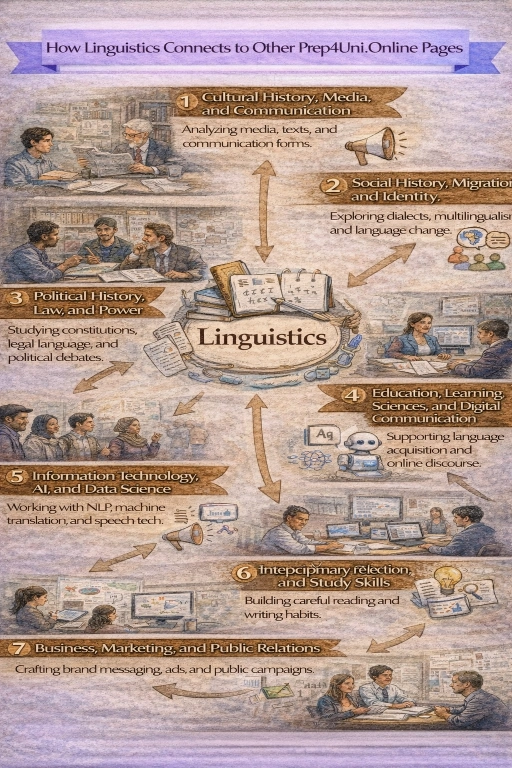
Linguistics rarely stands alone. Because language is present in every field of study, the concepts you meet in linguistics connect naturally to many other Prep4Uni.Online pages across the humanities, social sciences, STEM, and professional disciplines. Seeing these links can help you build a more integrated programme of self-study before university.
1. Cultural History, Media, and Communication
Many cultural history and media-related pages explore how ideas, beliefs, and power relationships are communicated across time. Linguistics offers tools for analysing the language used in religious texts, political speeches, advertisements, news reports, and social media. Concepts from sociolinguistics and discourse analysis help you read these materials more critically, noticing how word choice, metaphor, and framing shape public opinion and cultural memory.
2. Social History, Migration, and Identity
Social history topics such as migration, diaspora, and urban–rural change are closely tied to language. Linguistics sheds light on how dialects, multilingual practices, and language shift reflect broader social transformations. When you study migration and diaspora on Prep4Uni.Online, you can use ideas from contact linguistics and sociolinguistics to understand code-switching, heritage languages, and the politics of “standard” versus “non-standard” speech.
3. Political History, Law, and Power
In political history and law-oriented pages, you often encounter constitutions, treaties, legal judgments, and policy documents. Linguistics contributes methods for examining how these texts define rights, obligations, and boundaries of authority. Pragmatics and discourse analysis help explain how ambiguity, vagueness, or carefully chosen wording can influence interpretation in courts, elections, and public debates. This is particularly relevant if you are interested in areas such as constitutional history, diplomatic history, or international law.
4. Education, Learning Sciences, and Digital Communication
Pages on education, pedagogy, and digital communication connect strongly with applied linguistics. Insights into language acquisition inform how children and adults learn, while research on classroom discourse and feedback supports more inclusive teaching practices. In digital communication topics, ideas from pragmatics and discourse analysis help you understand how tone, emojis, and online platforms change the way we express politeness, disagreement, and identity.
5. Information Technology, AI, and Data Science
Linguistics also links directly to STEM-focused pages on information technology, artificial intelligence, and data science. Natural language processing (NLP), machine translation, speech recognition, and conversational agents all depend on models of phonetics, syntax, semantics, and discourse. If you explore AI, big data, or analytics topics on Prep4Uni.Online, a grounding in linguistics will help you see why human language is such a rich, challenging data source for computing.
6. Business, Marketing, and Public Relations
In business, marketing, and public relations pages, you will find many examples of persuasive communication, branding, and reputation management. Linguistics provides a toolkit for analysing slogans, campaign messaging, crisis communication, and cross-cultural negotiation. Understanding how language positions products, builds trust, or mitigates conflict helps you read case studies more sharply and design more effective communication strategies.
7. Interdisciplinary Reflection and Study Skills
Finally, linguistics supports your general study skills across Prep4Uni.Online: careful reading, precise writing, awareness of audience, and sensitivity to nuance. Whether you are working through history case studies, engineering explanations, or economics problem sets, noticing how language is used to define terms, build arguments, and present evidence will make you a more attentive and critical learner. In this way, linguistics becomes a quiet but powerful companion to almost every other page you explore.
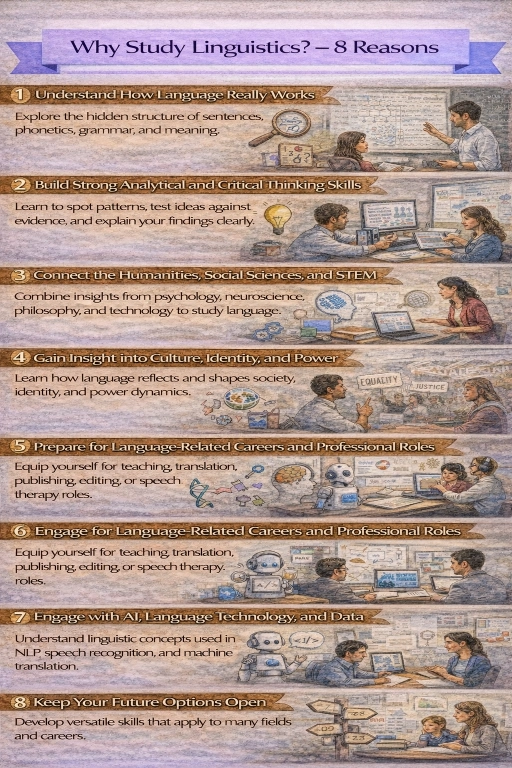
Why Study Linguistics? – 8 Reasons
1. Understand How Language Really Works
Everyday experience gives us the feeling that language is “natural” and effortless, but linguistics shows how much hidden structure lies beneath ordinary sentences. By studying phonetics, grammar, and meaning, you learn why some expressions feel “right” or “wrong”, how ambiguity arises, and how languages differ yet follow deep patterns. This gives you a more precise, evidence-based understanding of one of the most fundamental human abilities.
2. Build Strong Analytical and Critical Thinking Skills
Linguistics trains you to notice patterns, formulate hypotheses, and test them against real data. You learn to move from intuition to structured analysis: identifying patterns in sound systems, sentence structures, or word meanings, and explaining them clearly. These habits of mind are valuable for university study in any field that requires logical reasoning, careful argumentation, and attention to detail.
3. Connect the Humanities, Social Sciences, and STEM
Linguistics sits at the crossroads of many disciplines. It draws on philosophy and literature when dealing with meaning and interpretation, on psychology and neuroscience when exploring the mind and brain, and on computer science and data science in language technology. Studying linguistics helps you become comfortable crossing boundaries between qualitative and quantitative approaches – a key advantage in modern university programmes.
4. Gain Insight into Culture, Identity, and Power
How people speak is closely tied to who they are, where they come from, and how they are treated in society. Sociolinguistics and discourse analysis show how language reflects and shapes identity, inequality, and power. By examining dialects, multilingual practices, and public debates, you become more sensitive to issues of discrimination, inclusion, and respect. This perspective is especially valuable for fields such as social history, cultural studies, education, law, and politics.
5. Prepare for Language-Related Careers and Professional Roles
A background in linguistics supports many language-focused careers: language teaching, translation and interpreting, speech and language therapy (with further training), publishing, editing, and communication strategy. It equips you with technical knowledge about grammar, pronunciation, and meaning, as well as practical tools for designing courses, analysing texts, and communicating clearly across cultures and contexts.
6. Engage with AI, Language Technology, and Data
Modern AI systems that handle text and speech rely heavily on linguistic concepts. If you are interested in natural language processing, machine translation, conversational agents, or speech recognition, linguistics gives you a conceptual map of what “understanding” language involves. This makes it easier to collaborate with computer scientists, evaluate AI tools critically, and think about the ethical and technical challenges of language-based technologies.
7. Improve Your Own Communication and Language Learning
Studying linguistics helps you become more aware of how you speak, write, and listen. You learn why certain explanations work better for learners, why some sentences are clearer than others, and how subtle shifts in wording change the tone of a message. This awareness can make you a more effective writer, presenter, and language learner, strengthening your performance in essays, presentations, and group discussions across all subjects.
8. Keep Your Future Options Open
Because linguistics develops transferable skills – analysis, problem-solving, research, and communication – it keeps many pathways open. You can combine it with subjects like psychology, computer science, education, history, law, or business, and later specialise in whichever intersection interests you most. For students preparing for university, linguistics is an intellectually satisfying way to explore language while building a flexible foundation for a wide range of degree programmes and careers.
Summary – Linguistics Studies
Linguistics is the disciplined study of human language in all its dimensions – sound, structure, meaning, use, and change. It treats language not simply as a school subject, but as a complex system that can be described, modelled, and tested using real data. By examining how languages are organised and how people actually speak and write, linguistics builds bridges between the humanities, social sciences, and STEM.
At the core of linguistics are several key areas: phonetics and phonology (the sounds of language), morphology and syntax (the structure of words and sentences), semantics and pragmatics (meaning in context), and broader fields such as sociolinguistics, discourse analysis, psycholinguistics, and historical linguistics. Together, these strands help us understand how language is learned, how it varies across communities, how it evolves over time, and how it interacts with technology, culture, and power.
For students preparing for university, linguistics develops habits that are central to academic success: careful observation, pattern recognition, logical reasoning, and clear explanation. It invites you to move from “gut feeling” about language to systematic analysis, using examples, counterexamples, and evidence-based argument. These skills transfer directly to reading complex texts, writing structured essays, evaluating data, and engaging critically with debates in many disciplines.
Linguistics also opens up a wide range of study and career pathways. It can be combined with psychology, computer science, education, law, media, and business, among others. Graduates may work in language teaching, translation and interpreting, language technology and AI, publishing and communication, policy and planning, or research and academia. Even when you do not work “as a linguist”, the ability to listen closely, read carefully, and notice what language is doing beneath the surface remains a powerful advantage.
In short, linguistics studies invite you to look again at something you already use every day – language – and to see it with new clarity. As you explore related Prep4Uni.Online pages, you can treat linguistics as both a subject in its own right and a quiet companion, helping you make sense of texts, arguments, and communication across your entire journey into university and beyond.
Frequently Asked Questions: Linguistics
What is linguistics as a field of study?
Linguistics is the scientific study of language. It investigates how languages are structured, how they are used in context, how they change over time, and how they are processed in the mind and brain. Linguists analyse sounds, words, sentences, meanings, and conversations across many different languages and communities.
How is linguistics different from simply learning a language?
Learning a language focuses on using that language to communicate, while linguistics asks how language works in general. A linguist might study pronunciation systems, grammar patterns, meaning, and conversation in multiple languages, often comparing them. Language learning can be part of linguistics, but the main aim is analysis and explanation rather than fluency alone.
What are the main branches of linguistics?
Core branches of linguistics include phonetics (speech sounds), phonology (sound systems), morphology (word structure), syntax (sentence structure), semantics (meaning in words and sentences), and pragmatics (meaning in context). Important applied and interdisciplinary areas include sociolinguistics, psycholinguistics, historical linguistics, discourse analysis, and computational linguistics.
What kinds of questions do linguists ask?
Linguists ask questions such as: How do children acquire their first language? Why do languages change over time? What makes one sentence grammatical and another not? How do speakers signal politeness or power in conversation? How do bilinguals manage multiple languages? How can we model language in computers for translation or speech recognition?
What methods are used in linguistic research?
Linguistic research uses a range of methods, including close analysis of example sentences, fieldwork with speakers of under-documented languages, recording and measuring speech with acoustic tools, collecting and analysing large text or speech corpora, experiments on perception and comprehension, and building computational models of language structure and processing.
Is linguistics mainly about grammar rules and correcting mistakes?
No. Linguistics describes how people actually use language, rather than enforcing fixed rules of correctness. Linguists are interested in dialects, slang, and everyday speech as much as in standard varieties. They distinguish between prescriptive rules that tell people how they ought to speak and descriptive rules that explain how language works in real life.
How does linguistics connect with psychology, computer science, and sociology?
Linguistics connects with psychology through psycholinguistics and neurolinguistics, which study how language is processed and represented in the mind and brain. It connects with computer science through computational linguistics and natural language processing. It connects with sociology and anthropology through sociolinguistics, which examines how language varies across social groups, identities, and cultures.
What is sociolinguistics, and why is it important?
Sociolinguistics studies how language varies and changes across different social contexts. It looks at how factors such as region, class, ethnicity, gender, age, and setting influence pronunciation, vocabulary, grammar, and interaction styles. Sociolinguistics is important for understanding language attitudes, language policy, multilingualism, and communication in diverse societies.
What is applied linguistics?
Applied linguistics uses insights from linguistic research to address real-world issues. It includes areas such as language teaching and assessment, language planning and policy, translation and interpreting, literacy and reading, forensic linguistics, and communication in professional settings like healthcare or business.
What skills do students gain from studying linguistics?
Students of linguistics learn to analyse complex patterns systematically, work with data from different languages, construct and test hypotheses, and present clear, evidence-based arguments. They develop strong skills in critical thinking, formal reasoning, problem-solving, and precise written and oral communication, often across more than one language.
What kinds of careers can a linguistics background support?
A linguistics background can support careers in language education, speech and language technology, translation and interpreting, publishing, lexicography, language documentation and revitalisation, communications and marketing, forensic and legal language analysis, and research roles in universities or industry. It is also a strong foundation for further study in areas like speech therapy or computational linguistics.
How can students prepare for university-level linguistics?
Students can prepare by paying close attention to language in everyday life, noticing patterns in pronunciation, word choice, and grammar, and exploring introductory books or online resources about linguistics. Learning or comparing multiple languages, practising logic and basic formal notation, and developing good essay-writing and data-handling skills are also excellent preparation.
Linguistics – Review and Thought-Provoking Questions and Answers
Review Questions
1. What is linguistics, and how does it differ from simply “knowing a language”?
Answer: Linguistics is the scientific study of human language – its sounds, structures, meanings, and uses. It aims to describe and explain language systematically, using evidence and clear methods. Simply “knowing a language” means you can speak and understand it as a native or fluent user, usually without being able to explain the rules you follow. A linguist, by contrast, steps back and asks: What patterns are speakers using? How can we describe those patterns? How do they compare across languages? Linguistics therefore moves from intuition (“this sounds right”) to analysis (“this sounds right because the language has rule X and pattern Y”).
2. Briefly explain the difference between phonetics and phonology, and give one example of a question each field might ask.
Answer: Phonetics studies the physical side of speech sounds: how they are produced by the vocal tract, how they travel as sound waves, and how they are perceived by the ear and brain. A typical phonetic question might be: “What tongue and lip positions are used to produce the sound /r/ in different languages?” Phonology studies how sounds are organised and patterned within a particular language or across languages. A phonological question might be: “Why can English words begin with /str-/ (as in ‘street’) but not with certain other sound combinations, and how do speakers ‘repair’ illegal clusters?” Phonetics focuses on the physical details, while phonology focuses on how a language uses and organises those sounds.
3. How do morphology and syntax work together to create meaningful sentences? Illustrate with a short example.
Answer: Morphology deals with the internal structure of words (roots, prefixes, suffixes, inflections), while syntax explains how words combine into phrases and sentences. To express meaning, we need both word-level building blocks and rules for arranging them. For example, in the sentence “The researchers analysed the data carefully”, morphology explains forms such as research-er-s (root research + agent suffix -er + plural -s) and analys-ed (past tense). Syntax explains why “The researchers analysed the data carefully” is well-formed but “Analysed carefully the researchers data the” is not. Together, morphology and syntax allow us to form sentences that are both grammatically structured and meaningful.
4. What is the distinction between semantics and pragmatics, and why is context so important for understanding meaning?
Answer: Semantics studies the “literal” meaning of words and sentences as given by their structure and dictionary-like definitions. Pragmatics studies how speakers use those words in real situations to convey additional meanings, intentions, and attitudes. Context is crucial because the same sentence can convey very different messages. For example, “It’s cold in here” semantically describes the temperature, but pragmatically it might function as a request (“Please close the window”), a complaint, or a casual remark, depending on who is speaking, to whom, and where. Pragmatics shows that meaning is not just in the words, but also in the context of use.
5. Describe what sociolinguistics studies and explain how it might help us understand dialects, slang, or code-switching.
Answer: Sociolinguistics investigates how language varies and changes across different social groups, regions, age groups, genders, and situations. It asks how language reflects identity, group membership, and power relations. This perspective helps us see dialects not as “wrong versions” of a language, but as legitimate varieties associated with particular communities. Slang can be understood as a way for groups (for example, teenagers or online communities) to signal belonging and creativity. Code-switching – switching between languages or varieties in the same conversation – can be analysed as a resource for expressing identity, managing relationships, or shifting formality, rather than as a sign of confusion.
6. What kinds of questions do psycholinguistics and neurolinguistics ask about language learning and processing?
Answer: Psycholinguistics asks how language is processed in the mind: how we recognise words as we hear or read them, how we plan sentences before we speak, and how children acquire their first language so quickly. It might ask, for example: “How many milliseconds does it take for a listener to identify a word, and what factors make recognition easier or harder?” Neurolinguistics focuses on the brain structures that support language and what happens when they are damaged. It might ask: “Which brain areas are activated when a person understands a metaphor?” or “How do stroke-related injuries affect grammar or word-finding?” Together, these fields link linguistic theory to learning, memory, and brain function.
7. How does historical linguistics show that languages change over time, and why is this important for understanding language families?
Answer: Historical linguistics studies how languages evolve across centuries: sounds shift, grammar changes, new words are borrowed, and meanings drift. By comparing systematic sound correspondences and shared vocabulary, linguists can reconstruct earlier stages of languages and propose family trees (for example, the Indo-European family). This is important because it helps explain why languages that look different today (such as English, German, and Hindi) can be traced back to common ancestors. It also shows that no language is “fixed”; all are constantly changing. Understanding these processes helps us interpret old texts, track migration and contact, and appreciate the deep history of linguistic diversity.
Thought-Provoking Questions
8. If you speak more than one language or dialect, how does your way of speaking change across situations (family, school, online, formal events)? What might a linguist find interesting about these shifts?
Model answer: Many speakers notice that they use different words, accents, or sentence structures depending on context. With family, they might use an intimate home language or dialect; at school or work, a more “standard” variety; online, a mix of abbreviations, emojis, and borrowed expressions. A linguist would find it interesting that these shifts are often systematic rather than random. They reveal how speakers manage identity, politeness, and power: signalling closeness with some people, respect or distance with others, or belonging to a particular group. Analysing these patterns can show how social norms and expectations are encoded in everyday speech choices.
9. Many people believe that some varieties of a language are “proper” while others are “broken” or “incorrect”. How would a linguist respond to this belief, and what evidence might they use?
Model answer: A linguist would argue that all spoken varieties used by a community are systematic and rule-governed, not “broken”. What is often called “proper” is usually the socially prestigious variety associated with education, government, or media. Linguists can show that non-standard varieties have consistent grammar and pronunciation patterns; they are just different from the standard, not inferior. For example, if a variety regularly drops certain consonants or uses a different verb agreement pattern, speakers do so consistently, not at random. Evidence comes from detailed recordings and analyses of speech, which reveal stable rules. The idea of “broken language” is therefore more about social attitudes and power than about linguistic structure.
10. Think of a recent news article, political speech, or advertisement you have seen. How could discourse analysis help you understand what the speaker is trying to achieve beyond the literal words?
Model answer: Discourse analysis encourages us to look at how texts are organised, what is emphasised or omitted, and how certain groups or issues are framed. In a political speech, for example, analysts might examine repeated metaphors (“war on drugs”, “battle against inflation”), pronoun choices (“we” versus “they”), and the order in which problems and solutions are presented. These choices can create a sense of unity, blame, urgency, or reassurance even when the literal words sound neutral. In an advertisement, discourse analysis might look at how the product is linked to ideas of success, youth, or care, rather than just listing its technical features. The goal is to uncover the persuasive strategies operating beneath the surface.
11. As AI systems become better at handling text and speech, what do you think they still struggle with in human language (for example, humour, sarcasm, emotion, or cultural references)? Why might these aspects be especially challenging?
Model answer: AI systems still face difficulties with language that relies heavily on shared background knowledge, subtle tone, and unspoken assumptions. Humour, sarcasm, and irony often depend on recognising that what is said is the opposite of what is meant, or that a phrase echoes a well-known story, meme, or cultural reference. These aspects are challenging because they require more than pattern recognition; they demand an understanding of social context, history, and relationships between speakers. Even humans sometimes misinterpret jokes or irony online, where facial expressions and tone of voice are missing. For AI, modelling this rich, context-sensitive layer of meaning remains an ongoing challenge.
12. Languages are sometimes said to be “endangered” or “dying”. Why might communities and linguists care about preserving such languages, and what might be lost if they disappear?
Model answer: Communities and linguists care about endangered languages because each language embodies a unique way of seeing the world: its own stories, oral traditions, ecological knowledge, and ways of expressing relationships and values. When a language disappears, we lose not only vocabulary but also cultural memory and identity that are hard to translate fully into other languages. For communities, language loss can be tied to loss of pride, continuity, and connection to ancestors. For linguists, every language provides important data for understanding what is possible in human language as a whole. Preserving endangered languages is therefore about both cultural rights and scientific knowledge.
13. Imagine you are designing a school curriculum that takes linguistics seriously. Which topics (e.g. phonetics, sociolinguistics, language and power, language and technology) would you include, and how might they benefit students preparing for university?
Model answer: A balanced curriculum might include: basic phonetics (to raise awareness of sound patterns and pronunciation), grammar and sentence structure (to support clear writing), sociolinguistics and language and power (to address prejudice, identity, and inclusion), and language and technology (to connect with AI, translation, and digital communication). These topics would benefit students by making them more reflective readers and writers, more sensitive to diversity, and more aware of how language operates in media, politics, and technology. Such a curriculum would also train general skills—critical thinking, argumentation, data analysis—that are valuable across university subjects.
14. Consider an example of miscommunication you have experienced (face-to-face or online). How could concepts from pragmatics or sociolinguistics help explain what went wrong?
Model answer: Many miscommunications arise when speakers interpret the same words using different assumptions about politeness, directness, or context. From a pragmatics perspective, one person might intend a sentence as a gentle suggestion, while another hears it as a criticism because they apply a different set of conversational expectations. From a sociolinguistic perspective, different cultural or social backgrounds may lead to different norms about eye contact, silence, or how directly to refuse a request. Analysing a specific incident through these lenses can show that the problem is not simply that someone “said the wrong thing”, but that participants were operating with different, often invisible, rules for how language should be used.