
Overview
This final chapter integrates the principles developed throughout the course into practical, real-world systems involving fluid flow. Applications include high-speed flow through nozzles, hydrostatic and dynamic pressure loading on large structures like dams, lift generation on airfoils, and simplified analysis of blood flow in biological vessels. These examples show how fluid dynamics provides critical insight across engineering and biological domains.
- Use continuity and Bernoulli’s principles to model flow through converging/diverging pipes and nozzles.
- Compute aerodynamic lift based on pressure differences over a wing surface.
- Explain the role of flow velocity and vessel diameter in determining blood pressure and flow rate.
- Apply fluid dynamics to analyze forces acting on dam faces and spillways.
🎯 Learning Outcomes
By the end of this chapter, students will be able to:
- Model flow through nozzles and diffusers using mass continuity and Bernoulli’s equation.
- Understand how velocity and pressure distributions contribute to aerodynamic lift.
- Compute lift forces using the pressure differential across airfoil upper and lower surfaces.
- Estimate hydrostatic and dynamic fluid loading on dam walls, gates, and spillways.
- Analyze blood flow in constricted arteries using fluid conservation laws and pressure-flow relationships.
- Evaluate mechanical force amplification in hydraulic lifts using Pascal’s law.
Contents
- 7.1 Flow Through Nozzles and Diffusers
- 7.2 Lift on Airfoils and the Bernoulli Principle
- 7.3 Blood Flow in Arteries
- 7.4 Hydrostatic and Dynamic Loading on Dams
- 7.5 Hydraulic Lift and Pascal’s Law
- 7.6 Key Formula Recap
- 7.7 Interactive Hydraulic Lift & Airfoil Simulator
- 7.8 Frequently Asked Questions (FAQs)
- 7.9 End-of-Page Self-Assessment Exercises
7.1 Flow Through Nozzles and Diffusers
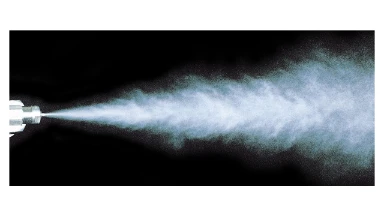
When pipe area changes, so does velocity. In a nozzle (converging section) the flow accelerates and static pressure drops; in a diffuser (diverging section) the flow decelerates and pressure recovers. The behavior follows the continuity equation and Bernoulli’s equation for steady, incompressible, inviscid flow.
- Continuity: Q = A v, so A1 v1 = A2 v2 (incompressible flow).
- Bernoulli (along a streamline):p + ½ρv2 + ρgh = constant

7.2 Lift on Airfoils and the Bernoulli Principle
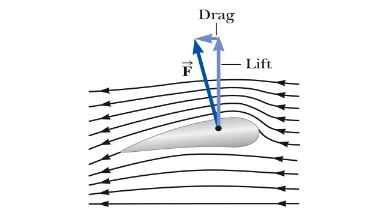
Faster flow over the cambered upper surface of a wing generally implies lower static pressure than beneath the wing, producing upward aerodynamic lift. A simple Bernoulli estimate uses the pressure difference between the two sides:
Δp = plower − pupper = ½ρ (vupper2 − vlower2)
Total Lift Force:
L ≈ Δp × Awing
Note: Real aircraft analysis incorporates fluid circulation and Kutta–Joukowski theorem (L’ = ρ V∞ Γ); the Bernoulli formulation provides a first-order pressure panel estimate.
7.3 Blood Flow in Arteries
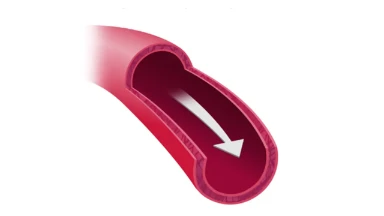
Blood is well approximated as an incompressible fluid in major blood vessels. In a narrowed artery (stenosis), the reduced cross-sectional area raises flow velocity and lowers static pressure, consistent with continuity and Bernoulli equations.
- Flow rate continuity: Q = A v ⇒ v2 = v1 (A1 / A2).
- Pressure change (horizontal vessel):p2 − p1 = ½ρ (v12 − v22)
7.4 Hydrostatic and Dynamic Loading on Dams
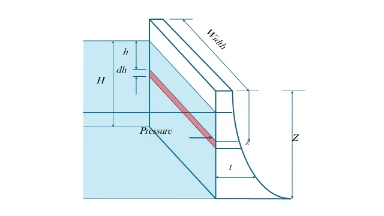
Hydrostatic pressure increases linearly with fluid depth y measured from the free surface: p(y) = ρ g y. The total horizontal force F on a vertical rectangular dam face of width b and water depth h is found by integrating pressure over the wetted area:
F = ∫0h ρ g y b dy = ½ ρ g b h2
Center of Pressure (Line of Action):
ycp = [ ∫0h y (ρ g y b) dy ] / [ ∫0h (ρ g y b) dy ] = (2 / 3) h below the free surface.
🤔 Engineering Puzzles: Dam Structural Mechanics
Puzzle 1: Why does dam-wall base thickness grow faster than linearly with depth?
Although gauge pressure p = ρgh grows linearly with depth h, the total horizontal force scales with h2 (½ρgbh2). Furthermore, the bending moment at the foundation base scales with h3 because the resultant force acts at a distance of h/3 above the toe. Factoring in uplift pressures, wave dynamics, and seismic safety, base thickness must scale quadratically or cubicly.
Puzzle 2: Why do arch dams curve with the convex side facing upstream?
Curving the dam convexly toward the upstream reservoir converts hydrostatic water pressure into internal compressive arch stresses. Concrete possesses high compressive strength but poor tensile strength. Arch geometry transfers massive fluid thrust directly sideways into solid bedrock canyon abutments.
7.5 Hydraulic Lift and Pascal’s Law
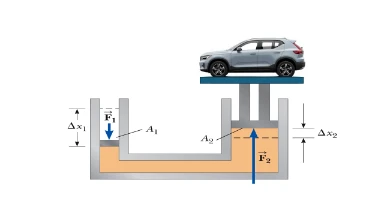
By Pascal’s law, pressure applied to a confined, static incompressible fluid is transmitted undiminished throughout every portion of the fluid and onto container walls:
Fluid volume conservation governs piston stroke displacements: if small piston 1 moves downward by distance s1, large piston 2 rises by distance s2 = s1 × (A1 / A2). Work done is conserved in the absence of friction (W = F1 s1 = F2 s2).
7.6 Key Formula Recap
| Concept | HTML Equation | Engineering Context |
|---|---|---|
| Continuity (Incompressible) | Q = A v, A1 v1 = A2 v2 | Volumetric flow rate conservation across variable areas |
| Bernoulli Equation | p + ½ρv2 + ρgh = constant | Mechanical energy conservation along streamlines |
| Airfoil Pressure Lift | L ≈ ½ρ (vupper2 − vlower2) Awing | Aerodynamic lift estimation from surface pressure differential |
| Hydrostatic Pressure | p(h) = ρ g h | Linear gauge pressure depth variation in static fluids |
| Hydrostatic Force on Dam | F = ½ρ g b h2, ycp = 2h/3 | Resultant horizontal fluid thrust and center of pressure line |
| Pascal’s Hydraulic Law | F1 / A1 = F2 / A2 ⇒ F2 = F1 (A2 / A1) | Static pressure transmission and force multiplication ratio |
7.7 Interactive Hydraulic Lift & Mechanical Advantage Simulator
Manipulate input force, small piston area, and large piston area to visualize Pascal’s law force multiplication, liquid displacement balance, and wetted mechanical equilibrium.
7.8 Frequently Asked Questions
How does fluid velocity change when flowing through a converging nozzle?
For an incompressible fluid, mass conservation requires volumetric discharge Q = A v to remain constant. In a converging nozzle where cross-sectional area decreases (A2 < A1), fluid velocity must increase proportionally (v2 = v1 × (A1/A2)). By Bernoulli’s equation, this acceleration drops static pressure.
Why does blood pressure drop inside a constricted arterial stenosis?
As blood passes through a narrowed vascular constriction (stenosis), continuity forces the blood to accelerate rapidly. In accordance with Bernoulli’s kinetic energy balance, the localized increase in dynamic pressure (½ρv2) causes static lateral blood pressure against the vessel wall to fall, potentially causing flexible arterial walls to collapse inward.
Where is the line of action for the total hydrostatic force on a vertical dam face?
Because hydrostatic pressure increases linearly with depth (p = ρgh), the pressure distribution against a flat vertical dam face is triangular. The centroid of a triangle lies at 2/3 of its total height from the apex, placing the center of pressure (line of action for resultant force F = ½ρgbh2) exactly 2/3 h below the reservoir free surface (or 1/3 h above the bottom base).
Does a hydraulic lift violate energy conservation principles when multiplying force?
No, hydraulic lifts strictly obey energy conservation. While the output force is multiplied by the piston area ratio (F2 = F1 × (A2/A1)), the displacement distance of the larger piston is reduced by the exact same ratio (s2 = s1 × (A1/A2)). Consequently, mechanical work input equals work output (W = F1 s1 = F2 s2).
📝 EXERCISES & SELF-ASSESSMENT MODULE
Section 1: Foundational Review Questions
-
What happens to fluid velocity and static pressure in a converging nozzle?
Answer: Velocity increases due to mass continuity (A1v1 = A2v2), causing static pressure to drop in accordance with Bernoulli energy conservation. -
State the simplified Bernoulli formula used to estimate aerodynamic wing lift.
Answer: L ≈ Δp × Awing = ½ ρ (vupper2 − vlower2) Awing. -
Define dynamic pressure and state its expression.
Answer: Dynamic pressure q = ½ ρ v2 represents fluid kinetic energy per unit volume. -
Write the formula for total hydrostatic force acting on a flat vertical dam face of width b and water depth h.
Answer: F = ½ ρ g b h2. -
At what depth below the free surface does the resultant hydrostatic force act on a vertical dam?
Answer: At the center of pressure located at ycp = 2/3 h below the free surface. -
State Pascal’s law as applied to hydraulic machinery.
Answer: Pressure applied to a confined static fluid is transmitted undiminished in all directions: p = F1 / A1 = F2 / A2. -
How does fluid flow rate Q relate to cross-sectional area A and mean speed v?
Answer: Q = A v. For incompressible fluids, Q remains uniform along closed conduits. -
What primary physical losses are ignored when applying ideal Bernoulli equations to spray nozzles?
Answer: Viscous shearing, fluid turbulence, friction head loss hf, and multi-phase air entrainment/mixing.
Section 2: Analytical & Thought-Provoking Scenario Questions
-
Why does a spinning baseball curve during flight (Magnus effect)?
Answer: Ball rotation drags boundary layer air, accelerating relative airflow on one side and decelerating it on the opposite side. By Bernoulli’s principle, the high-velocity side experiences reduced static pressure, creating a sideways aerodynamic force. -
Why do flexible vascular walls in a severely narrowed artery tend to collapse inward during high blood flow?
Answer: Stenosis constriction accelerates local blood velocity, causing internal static lateral blood pressure to drop below surrounding external tissue pressure, forcing vessel walls inward. -
How does a spillway bucket prevent erosion at the base of a high concrete dam?
Answer: It redirects high-velocity water discharge upward into a free ski-jump trajectory, dissipating kinetic energy safely in the air and plunge pool far away from the structural toe. -
Why do high-speed aircraft experience flow separation at high angles of attack?
Answer: Steep pressure gradients along the upper wing surface exceed boundary layer kinetic energy, causing fluid flow detachment, massive turbulence, and sudden aerodynamic loss of lift (stall). -
Why is the bending moment on a concrete gravity dam heavily dependent on reservoir depth?
Answer: Total hydrostatic force scales with h2 (½ρgbh2) and its moment arm scales with h (1/3 h above base), causing overturning moment to scale with h3. -
Why are hydraulic jack handles designed to require many small pumps to lift a heavy automobile?
Answer: Conservation of mechanical work dictates W = F1 s1 = F2 s2. To achieve immense output force F2 with small human force F1, small piston stroke displacement s1 must accumulate over many cycles. -
How does the Reynolds number dictate whether flow inside a pipe is laminar or turbulent?
Answer: Re = ρ v D / μ measures the ratio of inertial forces to viscous forces. Values below 2300 indicate smooth viscous damping (laminar), whereas values above 4000 signify inertial instability (turbulent). -
Why must energy loss terms be included when calculating flow rates in real-world pipe diffusers?
Answer: Expanding pipe geometry induces adverse pressure gradients (∂p/∂x > 0) that cause flow separation, boundary layer stall, and eddy formation, converting mechanical pressure energy into thermal energy.
Section 3: Numerical Problems with Detailed Solutions
-
A pipe reduces diameter from D1 = 10 cm to D2 = 5 cm. If upstream water velocity is v1 = 2 m/s, determine downstream velocity v2.
Solution:By continuity: v2 = v1 (D1 / D2)2 = 2 × (0.10 / 0.05)2 = 2 × (2)2 = 8.0 m/s. -
Airflow (ρ = 1.2 kg/m3) over an airplane wing moves at vupper = 40 m/s over the top surface and vlower = 30 m/s underneath. Calculate upward lift force per unit area.
Solution:Δp = ½ ρ (vupper2 − vlower2) = 0.5 × 1.2 × (402 − 302) = 0.6 × (1600 − 900) = 0.6 × 700 = 420 N/m2 (Pa). -
Calculate total horizontal hydrostatic force on a vertical dam face of height h = 10 m and width b = 20 m holding back fresh water (ρ = 1000 kg/m3, g = 9.81 m/s2).
Solution:F = ½ ρ g b h2 = 0.5 × 1000 × 9.81 × 20 × (10)2 = 9810 × 100 = 9.81 × 10⁶ N (9.81 MN). -
A hydraulic jack has a small piston of area A1 = 10 cm2 and a large piston of area A2 = 250 cm2. If a force of F1 = 200 N is applied to the small piston, compute the lifting force F2.
Solution:By Pascal’s law: F2 = F1 × (A2 / A1) = 200 × (250 / 10) = 200 × 25 = 5000 N (5.0 kN). -
Blood (ρ = 1060 kg/m3) flows through an artery at v1 = 0.30 m/s. It enters a stenosis where diameter is halved. Determine blood velocity v2 and pressure change p2 − p1.
Solution:1. v2 = v1 (D1 / D2)2 = 0.30 × (2)2 = 1.20 m/s.
2. p2 − p1 = ½ ρ (v12 − v22) = 0.5 × 1060 × (0.302 − 1.202) = 530 × (0.09 − 1.44) = 530 × (−1.35) = −715.5 Pa (Pressure drops by 715.5 Pa). -
Water discharges from a large storage tank through an orifice located h = 5 m below the open water surface. Calculate exit jet speed v assuming ideal flow.
Solution:v = √[ 2 g h ] = √[ 2 × 9.81 × 5 ] = √[ 98.1 ] = 9.90 m/s. -
An airplane wing with planform area Awing = 25 m2 experiences an average upper surface pressure of 98.0 kPa and lower surface pressure of 99.5 kPa. Compute total aerodynamic lift.
Solution:Δp = plower − pupper = 99,500 − 98,000 = 1500 Pa.
L = Δp × Awing = 1500 × 25 = 37,500 N (37.5 kN). -
In a hydraulic press, the small input piston moves down by distance s1 = 0.50 m. If the piston area ratio is A2/A1 = 20, how high does the large output piston rise?
Solution:By volume conservation: s2 = s1 × (A1 / A2) = 0.50 × (1 / 20) = 0.025 m (2.5 cm).
Return to Course Index: Prep4Uni Fluid Mechanics 1 Main Page